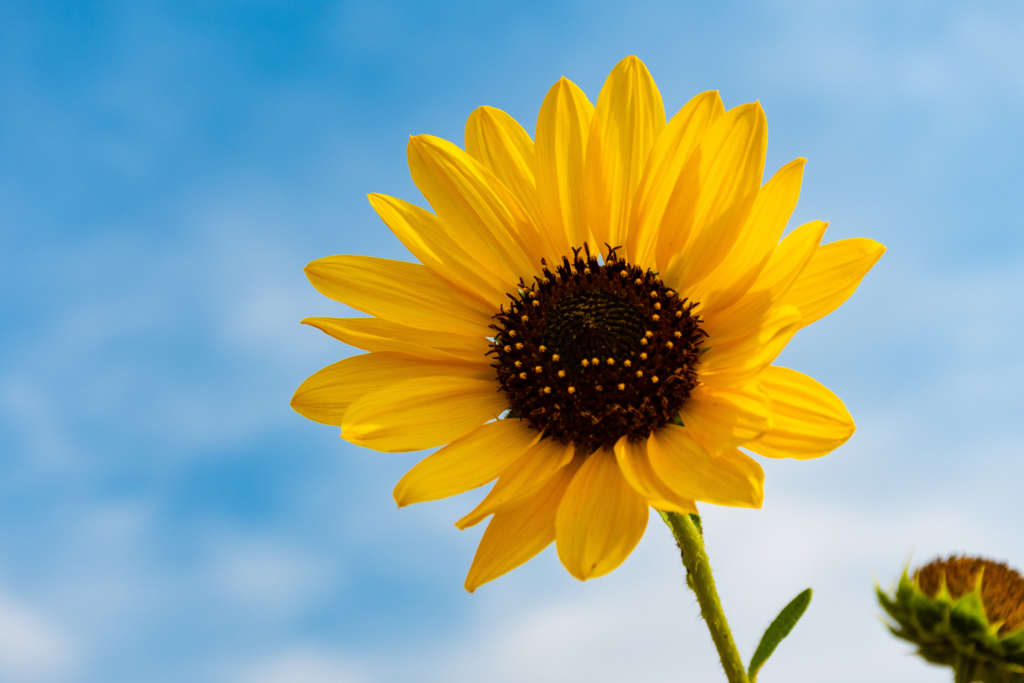
The common sunflower is a tall annual flower with a stout stem and broad leaves, and it terminates in a large composite flower head. Mature plants tend to be quite tall and have a vigorous, upright growth habit. The stem has rough, green leaves that alternate to maximize sunlight capture. Bright ray florets surround a dense central disc that contains hundreds of tiny flowers. Deep roots grow deep down into the soil to help the plant survive during drought.
A single-season flower
The common sunflower is a fast-growing plant and has a fast life cycle during one growing season. Flowers are typically in bloom during summer and early fall when pollinators are still active. The species thrives in sunny, open habitats and tolerates short periods of low moisture.
Supporting Biodiversity and Wildlife
Common Sunflower is important for biodiversity, providing nectar, pollen, seeds, and habitat resources. The flower head. Moreover, it is visited by bees, butterflies, beetles, and a wide variety of beneficial insects. Mature seeds are an important food source for birds. Small mammals that eat seeds also occupy sunflower habitats. It is native to grasslands, prairies, open fields, roadsides, and disturbed landscapes throughout much of North America; moreover, it is widely cultivated in agricultural systems, gardens, and restoration projects.
Floral Structure and Reproductive Cycle
A single common sunflower head can contain over a thousand individual florets arranged in mathematical spiral patterns called the Fibonacci sequence. Furthermore, these patterns often mirror the efficient packing structures found everywhere in nature. It reproduces by flowering, pollination, seed production, and dispersal by birds, mammals, water, and human activities. Pollinated florets produce seeds that are nutrient-rich and serve as food for many species of wildlife.
Threats and Ecological Importance
Threats range from fungal infections to insects, habitat loss, and stress in the environment. The conservation of species involves genetic diversity, as well as supporting native pollinators. Sunflowers are among the most popular flowers, since they are very large and highly significant within the ecological community and the agriculture sector. The ecological importance of annual flowering species is exemplified by their ability to support wildlife and their abundance of seeds. The plant continues to be an important resource for pollinators, wildlife, agriculture, and environmental education in the world.