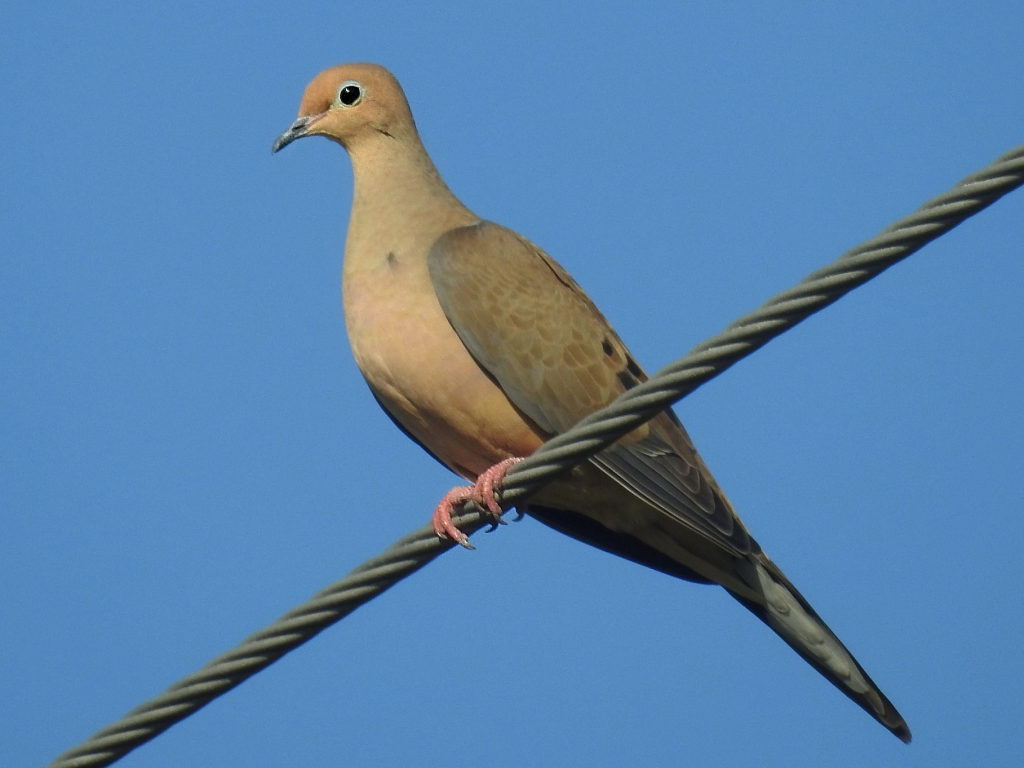
The Mourning Dove is one of the most familiar and widespread birds in North America. Recognized by its soft, mournful cooing and graceful flight, this slender-tailed dove can be found in a variety of habitats. Such as farmlands and grasslands to suburban gardens and city parks. Its gentle appearance and soothing calls have made it a favourite among bird enthusiasts.
Elegance on the Wing
Mourning Doves are medium-sized birds measuring 23–34 cm in length, with a wingspan of about 45 cm. They have a delicate brownish-gray body, black spots on their wings, a small head, and a long, pointed tail edged with white. Adult males often display a subtle pinkish tint on the chest and a blue-gray crown, while females are generally duller in color. Moreover, Mourning Doves are remarkably fast fliers. Their powerful wingbeats allow them to reach speeds exceeding 80 km/h, making them one of the fastest birds in North America. When taking flight, their wings produce a distinctive whistling sound as air rushes through specialized feathers. As a result, this sound may help warn nearby birds of danger.
A Life of Foraging
These doves spend much of their time foraging on the ground. They feed primarily on seeds, which make up about 99 percent of their diet. They consume seeds from grasses, grains, weeds, and cultivated crops. Furthermore, Mourning Doves have a unique feeding strategy. Instead of eating immediately, they quickly gather seeds and store them in a throat pouch called a crop.
Masters of Adaptation
Mourning Doves are known for their adaptability and can survive in environments ranging from suburban neighborhoods to arid deserts. In addition, they possess the unusual ability to drink slightly salty or brackish water without becoming dehydrated. Like other members of the pigeon and dove family, they can suck water through their beaks without tilting their heads backward.
Family Ties and New Beginnings
During the breeding season, males attract mates through cooing songs and elaborate flight displays. After pairing, the male gathers nesting materials while the female builds a simple platform nest of twigs. However, these nests are often surprisingly flimsy and may be placed in trees, shrubs, flower pots, or even on building ledges. Females usually lay two white eggs, and both parents share incubation duties for about 14 days. After hatching, chicks, known as squabs, receive a nutrient-rich substance called “crop milk” from both parents. Moreover, Mourning Doves reproduce frequently and can raise as many as six groups of chicks in a year in warm regions.
A Lasting Presence
Although more than 20 million Mourning Doves are harvested annually by hunters, they remain one of North America’s most abundant birds, with an estimated population of hundreds of millions. Therefore, their adaptability, gentle nature, and soothing calls continue to make them a cherished part of the continent’s bird life.