Forest Beauty Unveiled
The Rose-breasted Grosbeak is one of the most visually striking songbirds found in North American forests. Known for its bold colors and sweet, flute-like song, this bird is a seasonal visitor to deciduous woodlands, orchards, and forest edges across eastern and central North America.
Nature’s Perfect Contrast
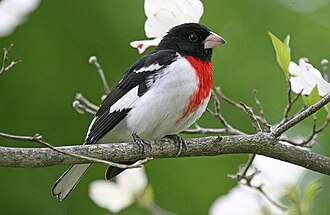
One of the most remarkable features of this species is its strong sexual dimorphism. The male is unmistakable, with a glossy black head, back, and wings contrasted by a bright white belly and a vivid rose-red triangle on its chest. This colourful patch gives the bird its name and makes it one of the easiest birds to identify in its range. However, the female looks entirely different. She is brown and heavily streaked with buff and white, resembling a large sparrow. Despite these differences, both sexes share a thick, conical bill that cracks hard seeds.
Journeys Beyond the Forest
Rose-breasted Grosbeak prefer open deciduous forests with a mix of tall trees and shrubs. They especially favour areas with edges or clearings rather than dense, continuous woodland. During migration, they may appear in a wide variety of wooded or semi-open habitats. They are long-distance migrants and travel at night between their breeding grounds in North America and wintering areas in Central and South America. There, they inhabit tropical forest edges and secondary growth.
Changing Seasons, Changing Diet
Their diet changes with the seasons. During the breeding period, they feed primarily on insects such as beetles, caterpillars, moths, grasshoppers, and spiders. These insects provide essential protein for raising young. In contrast, fall and winter bring a shift to seeds, fruits, and berries, including sunflower seeds, elderberries, and dogwood berries. These foods provide the energy needed for migration.
A Family in Bloom
Breeding occurs in late spring and summer. Males defend territories with a rich, rambling song and may engage in aggressive displays toward intruders. The female usually builds a loose cup-shaped nest from twigs, leaves, and rootlets in shrubs or deciduous trees. She lays 3–5 pale bluish-green eggs, and both parents incubate them for about two weeks. Afterwards, both parents feed the chicks, mainly with insects. Young birds leave the nest within 9–12 days but continue to receive care for some time after fledging. Typically, one or two broods are raised each year.
A Forest Treasure
Although their populations remain stable overall, Rose-breasted Grosbeak depend on healthy forest habitats and are sensitive to deforestation and habitat fragmentation. As a result, their presence often signals a thriving woodland ecosystem. Overall, with their striking appearance, beautiful song, and long migratory journeys, Rose-breasted Grosbeak remain one of the most admired birds of North American forests.