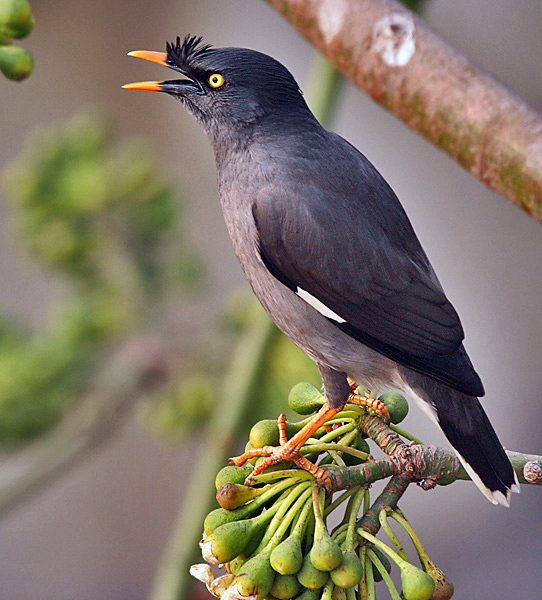
Grey Bird with a Flash of Flight
The Jungle Myna is a medium-sized member of the starling family, widely distributed across tropical southern Asia. It has a greyish body, yellow bill and legs, a prominent frontal crest, and white wing patches that flash during flight. Measuring about 23–24 cm in length, this bird shows little sexual dimorphism, with males only slightly larger than females.
Ground Forager of Diverse Habitats
Jungle Mynas adapt easily to open woodlands, forest edges, agricultural fields, plantations, and even urban surroundings. They avoid dry arid zones but thrive in human-altered landscapes, often living at elevations up to 2,000 meters. Their strong legs make them efficient ground foragers, while their sturdy bills help them probe soil and pick a wide variety of food.
Feeding Habits and Distinct Calls
These birds are omnivorous, feeding on insects, fruits, seeds, nectar, and occasionally small vertebrates like lizards. They also scavenge human food waste and may pick up parasites from livestock. Their vocalizations are distinctive, consisting of high-pitched “tiuck-tiuck” calls used for communication within pairs and flocks.
Group Living and Territory Defense
Jungle Mynas are social birds that often live in pairs or small groups and gather in communal roosts. However, they defend their territory during the breeding season. They do not migrate and stay in the same areas throughout the year.
Breeding Season Chronicles
Season of Commitment and Building Life
Breeding usually occurs from February to July, depending on the region. They are monogamous and nest in tree cavities, wall holes, palm sheaths, or other sheltered spaces. Both parents build the nest using twigs, leaves, grass, and even synthetic materials and line it with softer fibers.
Raising New Life Amidst Threats
Females lay 3–6 pale turquoise eggs, and both parents incubate them for about 14–22 days. The chicks hatch blind and featherless, and both parents care for them intensively until they fledge at around 20–26 days. Young birds remain dependent on their parents for several weeks for feeding and protection from predators such as snakes and crows, which sometimes leads to egg and chick losses.
Overall, the Jungle Myna is a highly adaptable, intelligent, and social bird that thrives in both natural and human-dominated landscapes, playing an important role in insect control and ecosystem balance.