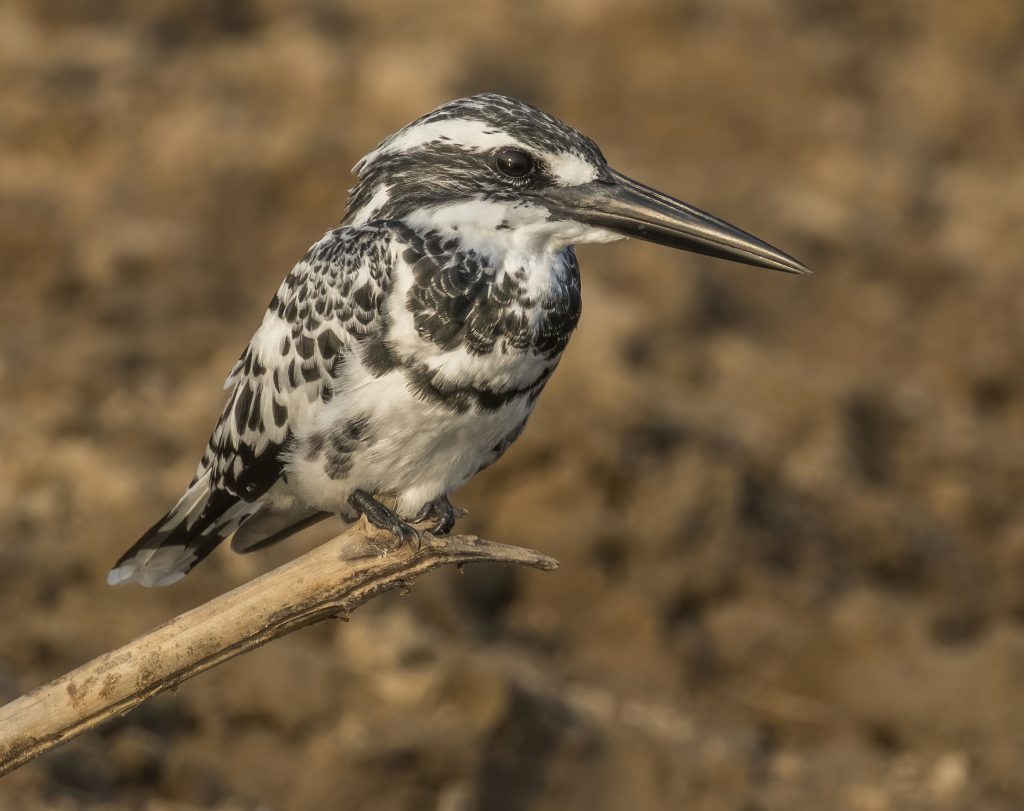
The Pied Kingfisher is a medium-sized, striking bird commonly found near rivers, lakes, and streams across Africa and Asia. It is one of the few kingfishers capable of hovering in place before diving into water to catch fish.
Bold Plumage and Adaptive Features
The pied kingfisher is recognized for its bold black-and-white plumage, and its appearance is both beautiful and functional. The black head and white underparts help it blend with contrasting backgrounds of water and sky, improving its hunting efficiency. Males display a distinct blue-black chest band, while females show a brown band, which helps in mate recognition during courtship. Its bluish back helps protect the bird from strong sunlight during long hours of perching and hovering.
From Hovering to Feeding
The pied kingfisher shows specialized adaptations for precision fishing. It hovers above the water by rapidly beating its wings before plunging headfirst to catch prey with remarkable accuracy. This hunting technique demands excellent vision and control, so the bird prefers habitats with clear water and abundant aquatic life. They are carnivorous and feed mainly on fish, but they also consume aquatic insects, amphibians, crustaceans, and small mollusks when available.
Building Bonds and Raising Young
Pied kingfishers are monogamous and form strong seasonal pair bonds. During the breeding season (February to April in many regions), males perform elaborate courtship displays, sometimes in groups, to attract females and offer food as part of bonding. Both partners cooperate to excavate long burrows, often about one meter deep, into riverbanks or sandy soil near water.
Females typically lay 4–5 white eggs, and both parents incubate them for about 18 days. After hatching, chicks remain in the nest for roughly three weeks before fledging. Even after leaving the nest, young birds continue to depend on parental care until they become independent.
Thriving in Changing Freshwaters
Although currently listed as a species of least concern, Pied Kingfishers are still monitored due to their dependence on freshwater habitats, which can be affected by pollution, dam construction, and habitat degradation. Fortunately, their wide distribution and adaptability have allowed populations to remain stable.
Overall, the Pied Kingfisher is a remarkable example of precision hunting, ecological balance, and adaptation, playing an essential role in freshwater environments while captivating observers with its hovering flight and striking plumage.