Appearance and Adaptations
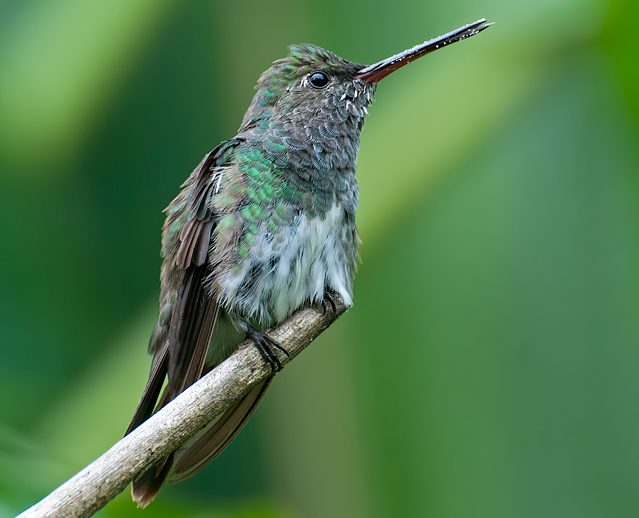
The Glittering-throated Emerald is a small hummingbird measuring 8–12 cm in length and weighing 3.5–6.2 g. It has a compact body, a straight bill with a blackish upper and pinkish lower mandible, and a forked dark tail. Adult males display shimmering golden- to bronze-green upperparts and a glittering golden-green throat and upper breast. The lower breast and belly are white, while the undertail coverts are white with brownish centers. Females resemble males but have white-barred throat feathers and greenish-gray outer tail tips. Juveniles are similar to adult females but have a duller, grayish-brown breast.
The wings beat at incredible speeds, enabling sustained hovering, sudden changes of direction, and accurate feeding in and around flowers. Microscopic feather structures reflect specific wavelengths rather than pigments, so brilliant iridescent feathers appear different in shifting light. One incredible scientific fact is that this structural coloration produces its jewel-like brilliance without green pigments.
One of the Smallest Bird in the World
The Glittering-throated Emerald is one of the smallest birds found in South America, measuring about 8–10 cm in length. It feeds mainly on nectar from flowers and also consumes small insects and spiders. Like other hummingbirds, it can hover in front of flowers while feeding, using its rapid wingbeats to remain suspended in the air. Despite its tiny size, the Glittering-throated Emerald is an agile and active flyer, moving quickly between flowers as it searches for food.
Diet and Ecological Role
The Glittering-throated Emerald feeds on floral nectar, which it obtains from a wide variety of flowering plants with its long extensible tongue. Small insects and spiders are a vital source of protein, which supports feather growth, reproduction, and overall development. The species plays an important ecological role in transferring pollen as it moves efficiently between blossoms, contributing to the successful reproduction of many flowering plants.
Habitat and Behavior
The Glittering-throated Emerald inhabits tropical forests, forest edges, mangroves, savannas, gardens, plantations, and riverine habitats across northern South America and Trinidad. Individuals are small but are apt to fiercely defend productive feeding territories from other hummingbirds. Courtship includes spectacular aerial displays, rapid flights, and vocal signals by males to attract females.
Females build small cup-shaped nests of soft plant fibers, moss, lichens, and spider silk, anchored firmly to slender branches, independently. Spider silk is remarkably flexible, permitting nests to expand naturally as growing chicks develop. Females typically lay two white eggs and incubate, feed, and raise the young by themselves until they fledge.
Predators include larger birds, tree snakes, lizards, and small mammals that can reach nests. Adults evade danger through extraordinary maneuverability, fast flight, and alert behavior.
Conservation Status and Threats
The Glittering-throated Emerald is considered Least Concern due to its wide range, though population trends remain unknown. No major threats have been identified, but habitat alteration, forest fragmentation, pesticide use, and localized environmental degradation may reduce the availability of suitable feeding and nesting resources. Protected habitats, conservation of flowering plants, and sustainable landscape management help maintain healthy populations across much of the species’ range.
The Glittering-throated Emerald is one of the most mesmerizing hummingbirds, owing to its eye-catching plumage, amazing flight skills, its unique pollination role, and remarkable adaptations that demonstrate the incredible variety and evolutionary complexity of tropical nectar-feeding birds.