Life in Open Landscapes
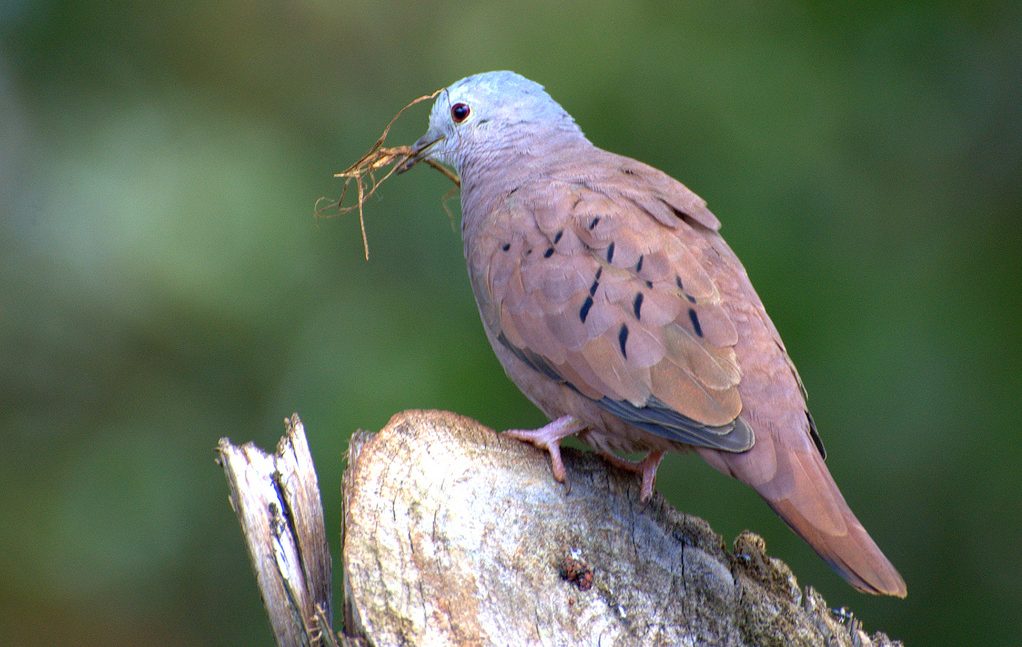
The ruddy ground dove is a small tropical dove found from northern Mexico through Central America, the Caribbean, and much of South America. Although generally non-migratory, it has recently expanded into the southwestern United States. It inhabits open landscapes, including deserts, shrub lands, farmland, and urban areas.
Living Alongside People
This adaptable bird thrives in environments where food is readily available and vegetation provides adequate shelter. It commonly forages along roadsides, in agricultural fields, parks, gardens, and open grassy spaces. Due to its ability to live comfortably near human settlements, the ruddy ground dove has become a familiar sight in many towns and villages throughout its range.
Searching for Every Seed
Despite its small size, the ruddy ground dove is a swift and agile flyer. Its plumage blends remarkably well with dry grass, fallen leaves, and bare soil, providing excellent camouflage from predators while it feeds or rests on the ground. The Ruddy ground dove primarily feeds on small grass seeds, which it picks directly from bare soil or sparse vegetation. In addition, it supplements its diet with insects and small snails. Like many ground-feeding birds, it spends much of the day searching for food in pairs or small groups. During the dry season, it often visits areas where seeds have accumulated after harvesting or natural seed dispersal.
Soft Calls Across the Fields
The ruddy ground dove communicates through a series of soft, repetitive calls that birdwatchers often describe as “kitty-woo,” “per-whoop,” or “p-ter-woo.” These gentle vocalisations are common during the breeding season and help the birds maintain communication between mates and establish territories. Their quiet calls are most noticeable during the early morning and late afternoon when bird activity peaks. Unlike louder pigeon species, the ruddy ground dove’s soothing coos blend harmoniously into the surrounding environment.
A Family Takes Shape
During the breeding season, males perform gentle courtship displays that include bowing, cooing, and other visual signals to attract females. Once paired, both birds work together throughout the nesting cycle. They build a sturdy, shallow cup-shaped nest from straws, twigs, and roots. They usually place it 1–2 meters above the ground in the fork of a tree or shrub surrounded by dense vegetation. While one bird gathers nesting materials, the other carefully arranges them. Dense leaves and branches conceal the nest, helping protect the eggs and chicks from predators.
Thriving in the Wild
The IUCN classifies the ruddy ground dove as Least Concern because of its extensive range, large and increasing population, and remarkable adaptability. No major threats currently affect the species, and it does not require targeted conservation measures. The ruddy ground dove also plays an important ecological role by dispersing seeds and helping control small invertebrate populations, contributing to the health of the ecosystems it inhabits. Although the species is currently secure, preserving natural habitats and green spaces will help maintain healthy populations of the ruddy ground dove and many other native bird species in the future.