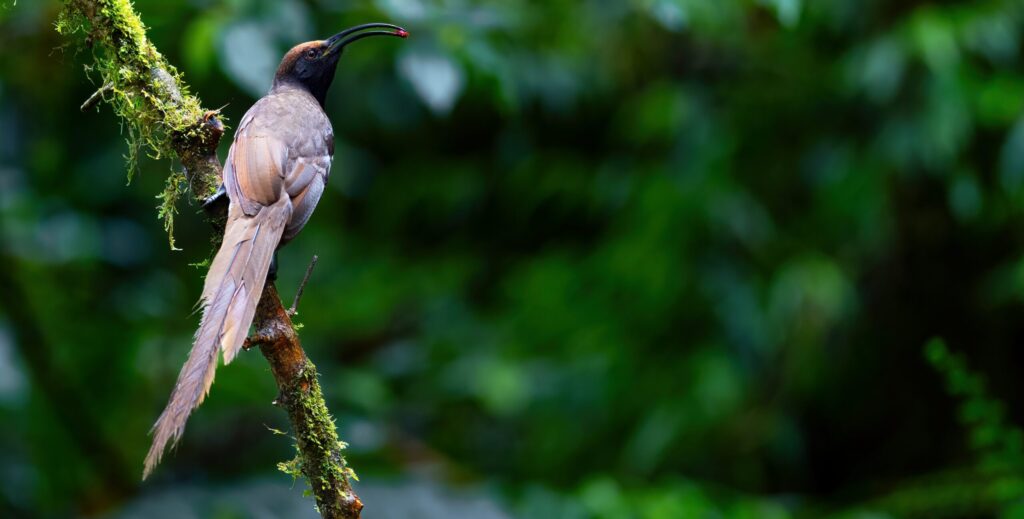
The Black Sicklebill is a bird-of-paradise with velvety black plumage, long body and dramatic curved bill. Adult males have an iridescent sheen that changes with light, providing soft flashes of color. Its long tail feathers enhance an already graceful form and the dark eyes complete its unique profile. Its curved bill is perfectly adapted to foraging on nectar from deep-seated flowers.
They feed on fruits, spiders and small insects giving it a varied diet to fuel its active lifestyle. The species plays an important ecological role by transferring pollen between flowers during feeding visits. Black Sicklebills are mostly resident throughout the year. Local movements may occur in response to the cycles of flowering and food availability.
A colorful display of courtship
Males are especially well known for elaborate courtship displays and during these performances, feathers are arranged into unusual shapes that dramatically change the bird’s appearance. The females will assess the quality of the display in choosing a mate. This complex behavior has attracted scientific interest for decades.
Hunters and protection from threats
The species lives in the mountain forests where the cool temperature and richness of the vegetation create favorable conditions. Females are primarily responsible for nesting duties. They conceal their ‘cup’ shape nest by placing in dense vegetation. Their eggs and nestlings are continuously protected by the female from predators include snakes, raptors and arboreal mammals those can reach nests. Dense forest cover provides important protection from these threats.
Evolution and adaption
One of the amazing features is the bizarre bill shape that has a remarkable resemblance to some flower types. Another stunning fact is the male’s capacity to completely change his silhouette during courtship displays. Researchers are still working to understand these displays that are among the most specialized in the bird-of-paradise world.
The Black Sicklebill is a remarkable example of an evolutionary adaptation involving feeding, reproduction, and forest ecology. Its spectacular display behavior, its specialized nectar feeding habits, and its striking appearance make it one of the most interesting of New Guinea’s mountain forest birds.