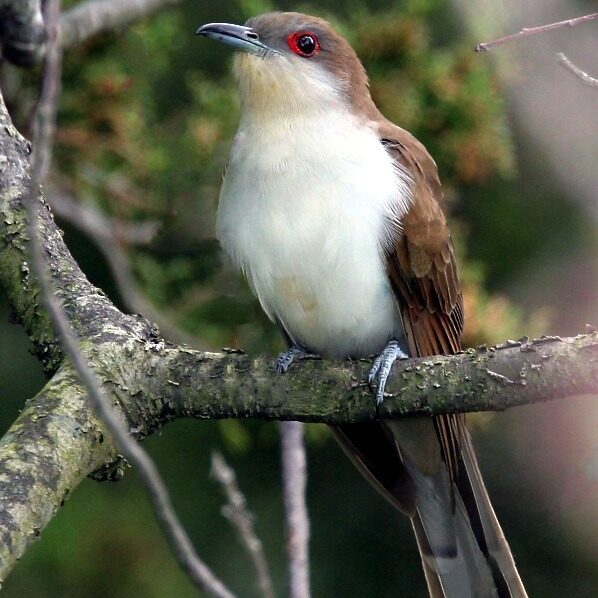
The Black-billed Cuckoo is a secretive woodland bird found across much of eastern and central North America. A slender, long-tailed bird, quietly moves through dense shrubs and leafy thickets, making it one of the most elusive birds in its range.
The slender cuckoo measures between 28 and 32 cm in length, with a wingspan of 40 to 45 cm and a weight of 45 to 65 grams. It has grayish-brown upperparts and white underparts. It is distinguished by its entirely black bill, bright red eye-ring in adults, and long tail marked with narrow white spots underneath. Juveniles are duller in appearance and possess a buff-colored eye ring.
The Black-billed Cuckoo is best known for its extraordinary appetite for caterpillars. It feeds heavily on hairy caterpillars such as tent caterpillars and fall webworms, prey that many birds avoid. During insect outbreaks, a single cuckoo may consume more than 100 caterpillars in a day. Its diet also includes beetles, cicadas, grasshoppers, katydids, snails, berries, seeds, bird eggs, and occasionally small fish.
Adaptability at the core
One of its most remarkable adaptations is the ability to shed the lining of its stomach. This enables the bird to safely digest hairy and spiny caterpillars by removing indigestible hairs and spines that accumulate in the digestive tract. This unique trait allows the Black-billed Cuckoo to exploit a food source that few other birds can utilize effectively.
Foraging usually takes place in dense shrubs and trees, where the bird quietly hops and climbs through branches while searching for prey. Its zygodactyl feet, with two toes facing forward and two backward, provide a secure grip while moving through vegetation.
Black-billed Travelers in the night
The species breeds across southern Canada and much of the eastern United States, favoring deciduous woodlands, shrubby forest edges, marsh borders, and second-growth forests. During migration, it seeks dense vegetation for shelter. A long-distance migrant, the Black-billed Cuckoo spends winters in northern South America and migrates mainly at night.
During the breeding season, males attract females with a series of soft, rhythmic “cu-cu-cu-cu” notes. Courtship often includes the male presenting food to the female. Both sexes help build a loose platform nest of twigs, leaves, grasses, and pine needles, usually hidden in dense shrubs or small trees. Females typically lay two to five blue-green eggs, although larger clutches may occur during years of abundant insect populations. Both parents incubate the eggs for 10 to 14 days and share responsibility for feeding the chicks.
All seasons’ planners
The Black-billed Cuckoo is also notable for its flexible breeding strategy. During periods of exceptional food abundance, some females may lay eggs in the nests of other cuckoos or even other bird species, a behavior known as facultative brood parasitism. This allows them to maximize reproductive success when resources are plentiful.
Although currently classified as a species of Least Concern, Black-billed Cuckoo populations have declined in parts of their range due to habitat loss, forest fragmentation, pesticide use, and collisions with buildings during migration. Nevertheless, the species remains an important natural controller of insect populations and a fascinating resident of North America’s forests.
With its secretive habits, unusual feeding adaptations, and mysterious calls echoing through woodland thickets, the Black-billed Cuckoo remains one of the continent’s most intriguing and overlooked birds.