- Scientific Name
- Impatiens capensis
- Location
- North America
- Habitat
- Forest Wetland, Stream Banks, Woodland Garden
- Season
- Fall, Summer
Overview
Spotted Jewelweed, also known as spotted touch-me-not, is a fast-growing annual wildflower native to North America. It thrives in moist, shaded habitats, including wetlands, stream banks, floodplain forests, bogs, woodland edges, and ditches. Additionally, it prefers humus-rich, slightly acidic to neutral soils and tolerates temporary flooding.
Characteristics of Jewelweed
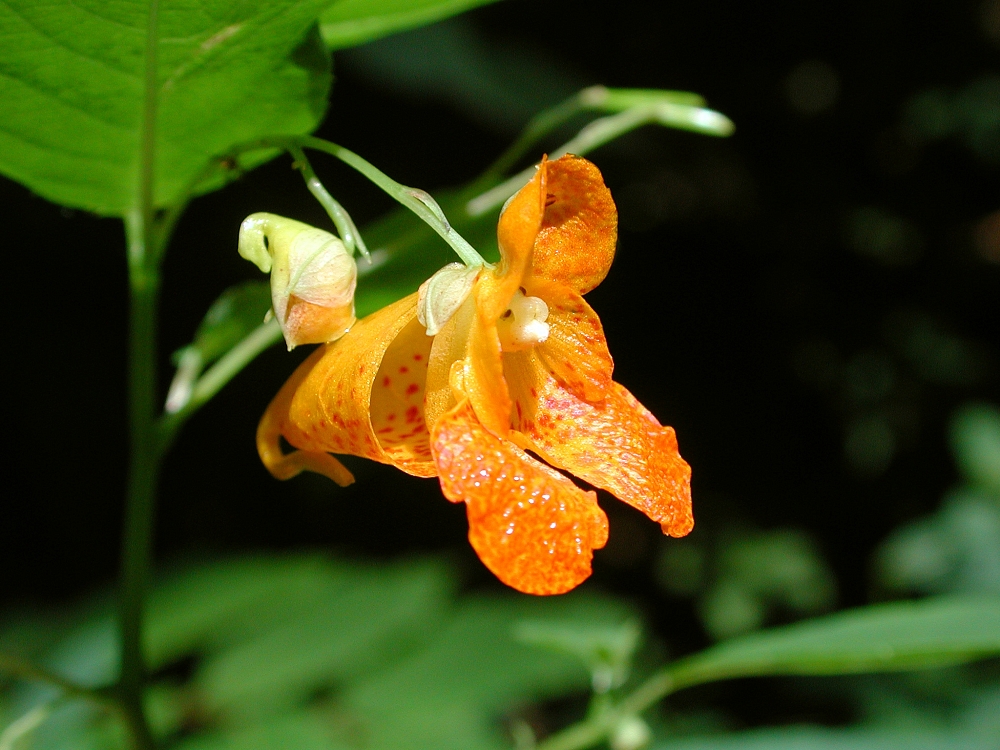
Spotted Jewelweed grows 2–5 feet tall with smooth, succulent, pale green to reddish, semi-translucent stems. Its bluish-green, oval to egg-shaped leaves grow alternately along the stems and have broad, rounded teeth along the margins. From late spring through early fall, the plant produces clusters of one to three drooping, tubular flowers in shades of orange to orange-yellow, usually marked with reddish-brown spots.
Furthermore, each flower has a distinctive curved nectar spur that attracts hummingbirds, bees, butterflies, and other pollinators. After flowering, slender green seed capsules develop. When mature, they burst open at the slightest touch, dispersing the seeds, which remain dormant through winter before germinating the following spring.
Cultivation
Spotted Jewelweed grows best in partial to full shade with consistently moist, organically rich soil. It prefers cool, humid conditions and needs regular watering to prevent the soil from drying out. Compost improves growth in nutrient-poor soils, while supplemental fertilizer is rarely necessary. Because it spreads easily by producing many seeds, removing the seed pods before they ripen can help prevent the plant from spreading too much.
Uses of Spotted Jewelweed
People value Spotted Jewelweed as an ornamental wildflower for shade and woodland gardens. Traditionally, Indigenous peoples and herbalists have used its leaves and stems to soothe minor skin irritations, insect bites, and poison ivy rashes, although scientific evidence for these uses remains limited. In addition, the nectar-rich flowers provide an important food source for hummingbirds, bees, and butterflies, making the plant valuable for pollinator-friendly and native habitat gardens.
Pests and Problems
Spotted Jewelweed experiences few serious pest or disease problems. However, prolonged drought can cause drooping leaves and premature leaf drop, while frost damages young plants. Therefore, under favorable conditions, it self-seeds aggressively and may spread rapidly, becoming weedy in some regions.