Australia’s Beloved Little Parrot
Budgerigar, commonly known as the budgie or parakeet, is a small, colorful, seed-eating parrot native to Australia. It is one of the world’s most popular companion birds, admired for its intelligence, playful personality, and ability to mimic human speech.
Small, Bright and Beautiful
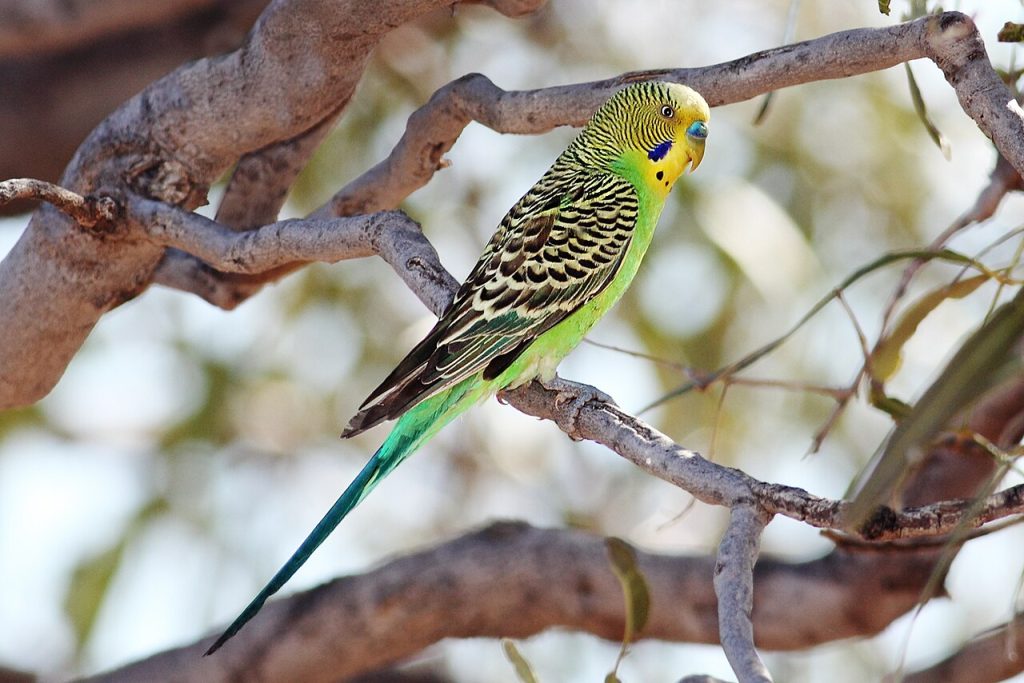
Budgerigars measure about 18 cm in length. Wild birds have bright green plumage, a yellow face and forehead, black barring on the back and wings, blue-violet cheek patches, black throat spots, and a long cobalt-blue tail. Young birds have black stripes extending to the cere until they are about 3–4 months old. The bill is olive-grey, while the legs and zygodactyl feet are bluish-grey. Adult males have a blue or lavender cere, whereas females have a whitish or pale brown cere that turns dark brown during the breeding season. Juveniles of both sexes have pinkish ceres.
Life in the Australian Outback
Budgerigars inhabit open woodlands, grasslands, shrublands, and lightly wooded areas across Australia. They are highly nomadic, traveling in flocks of 100–1,000 birds in search of food and water following seasonal rains. They nest mainly in natural tree hollows, especially in eucalyptus trees.
Built for a Seed-Based Diet
Their diet consists primarily of grass seeds, but they also feed on fruits, vegetables, herbs, and other plant material when available. Their strong, curved beaks are well adapted for cracking seeds, while their zygodactyl feet help them climb, perch, and handle food efficiently.
Smart, Social, and Talkative
Budgerigars are highly social, intelligent birds that communicate through a variety of chirps, whistles, and contact calls. They also use body language, including head bobbing, wing fluttering, tail movements, and beak grinding. In captivity, they often form close bonds with their owners and are capable of learning words, sounds, and simple tricks, with males generally being more vocal than females.
Breeding and Life Cycle
Budgerigars are monogamous and usually breed after seasonal rains when food is plentiful. They nest in tree hollows, fence posts, logs, and readily accept nest boxes in captivity. The female lays 4–8 white eggs and incubates them for 18–21 days, while the male feeds her and later helps care for the chicks. Young birds fledge at about 5 weeks but continue to rely on their parents for another 1–3 weeks, becoming fully independent at 6–8 weeks.
Survival in Stunning Colors
In the wild, budgerigars are preyed upon by falcons, hawks, kestrels, snakes, feral cats, and foxes. Since the 1850s, selective breeding has produced numerous color and feather varieties, including blue, albino, lutino, violet, cinnamon, pied, opaline, spangled, greywing, and many others.
Seen in Peppa Pig
The budgerigar features in the popular kids’ show, Peppa Pig. The blue-colored bird character of Binkey is introduced to Peppa and her friends as Dr. Hamster’s (the vet’s) pet bird.
A favorite among everyone
Today, the budgerigar remains one of the world’s most beloved pet birds. Its cheerful nature, vibrant colors, remarkable intelligence, and affectionate behavior continue to make it a favorite among bird enthusiasts worldwide.