The World’s Largest Penguin
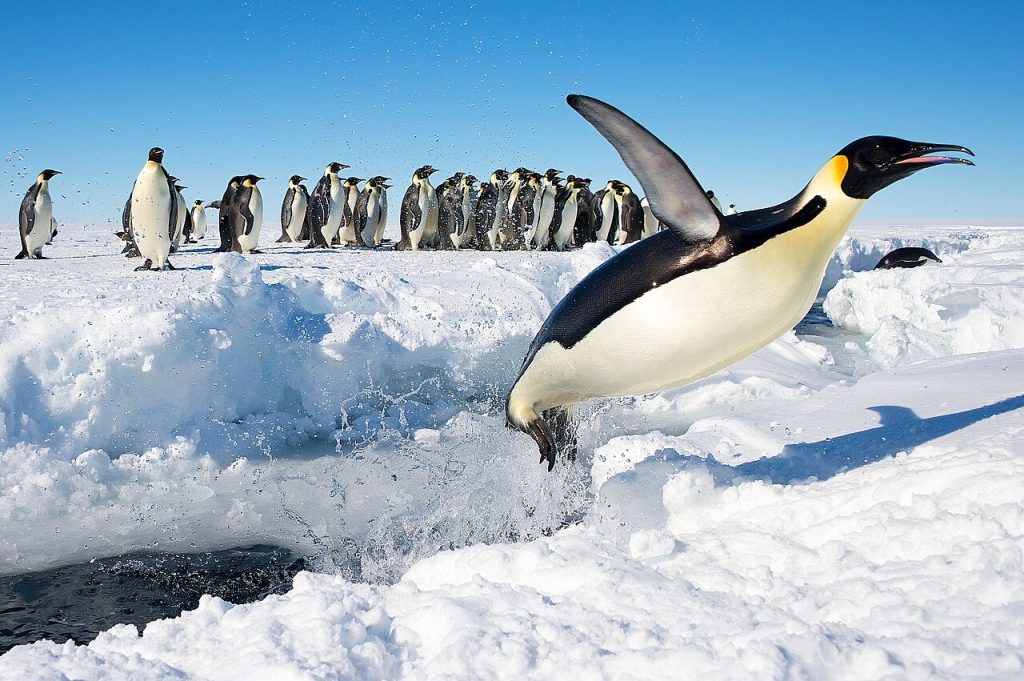
The Emperor Penguin is a flightless seabird with a streamlined body, dense waterproof feathers, short tails, and powerful flippers. It has a distinctive black-and-white plumage that offers effective camouflage while swimming in the ocean. They are the tallest and heaviest penguins in the world. Adults can grow up to 1.2 meters (4 feet) tall.
Engineered for the Ocean
Their solid bones reduce buoyancy, making them efficient swimmers in the water rather than flyers in the air. Strong webbed feet and muscular legs help them to walk over the land and through the icy waters. It is interesting to note that penguin feathers are tightly packed trapping insulating air and an oily coating improves waterproofing for long dives. Another remarkable scientific fact is that Emperor Penguins can dive over 500 meters deep and stay under the water for more than 20 minutes on their hunting trips.
Hunting Beneath the Ice
Penguins eat mainly fish, squid, krill, and other marine life caught with sharp bills and streamlined swimming motions. Their hunting behavior maintains balanced marine food webs while moving nutrients between the ocean and breeding colonies.
Where Penguins Live
Penguins are found on the coasts of Antarctica, sub-Antarctic islands, South America, Africa, Australia, and New Zealand, on rocky shores, sea ice, and offshore islands. Most species are strongly associated with productive marine environments and do not migrate across continents over long distances.
Breeding and Family Life
Courtship consists of vocal calls, synchronized displays, and mutual preening, all of which strengthen pair bonds before breeding. Nesting behavior varies widely, with some species building nests of pebbles, others burrowing, and many incubating eggs directly on their own feet in specialized brood pouches. Both parents usually share the incubation and chick-rearing duties by alternating shifts for feeding trips at sea.
Outsmarting Predators
Predators include leopard seals, killer whales, sharks, skuas, giant petrels, and introduced mammals that threaten eggs or chicks in some breeding colonies. Penguins depend on living in colonies, coordinated vigilance, and swift underwater agility to mitigate predation risks.
Protecting Penguin Populations
The Emperor Penguin is currently classified as Near Threatened. Climate change is reducing the extent and stability of Antarctic sea ice, which is essential for breeding and raising chicks. Additional threats include changes in ocean conditions, declining food availability, and increasing human activity in the Southern Ocean. Conservation efforts focus on protecting marine habitats, monitoring breeding colonies, reducing greenhouse gas emissions, and managing fisheries sustainably to safeguard their food supply.
Featured in Peppa Pig
The Emperor Penguin is one of the birds to be animated and featured in the kids’ show, Peppa Pig. In multiple episodes, Peppa and her friends visit and interact with Penguins on the show. There is also an episode where she goes to the South Pole to visit her friend and meets Penguins!
Icons of the Southern Seas
Penguins are still among the most recognizable birds on the planet. They swim very well, have complex social behavior, and have made incredible adaptations to life in the sea. Their story is an example of how evolution can turn a lineage of fliers into highly specialized ocean predators and do so very successfully.