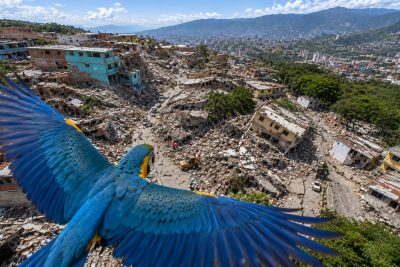
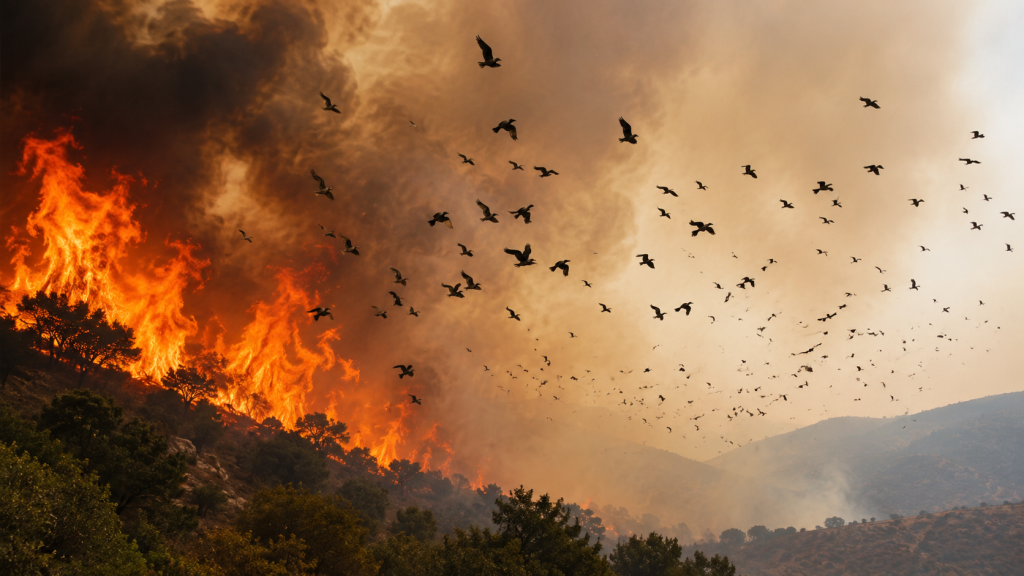
Disasters of nature may change whole landscapes within mere minutes. For instance, forests are shaken by earthquakes; coastlines are flattened by hurricanes; and whole habitats are consumed by fires. When speaking about natural disasters, people usually pay attention to the impact that disasters have on people. However, there is one more group that suffers greatly from natural disasters – birds. The nests, food resources, and breeding places of birds disappear because of natural disasters. However, there are numerous species of birds that have developed unique abilities which allow them to survive in the conditions of extreme changes.
Birds and Natural Disasters
There are several natural disasters like earthquakes, hurricanes, and wildfires. Birds react differently to natural disasters depending on whether they come before or after the natural disasters. Scientists noticed strange behaviour of birds before some natural disasters; hence, there is an interesting question: what do birds know that we do not?
Earthquakes and Tsunamis
Earthquakes happen suddenly, which makes them among the hardest types of catastrophes for wildlife. Seismic activity can ruin nests, uproot trees, and harm wetlands and forests where birds forage and reproduce. Birds lack food supplies; therefore, they need to leave for other safe places.
During the 2004 Indian Ocean earthquake and tsunami, people noticed a decrease in the number of Cattle Egrets (Bubulcus ibis) and House Crows (Corvus splendens) near the shores before the wave hit. Although these findings are often mentioned, there is no evidence to suggest that birds predict the catastrophe. They just might be influenced by some environmental changes that were unknown to humans.
Birds return slowly after an earthquake as vegetation comes back, while some of them migrate forever due to habitat loss.
Hurricanes and Storms
Hurricanes involve strong winds, rainfall, and flooding, which may wipe out bird nests, uproot trees, and change the face of whole coastlines. Forest-dwelling and coastal birds are forced to evacuate, losing not only their home but their source of food as well.
One of the best-known cases is the Golden-winged Warbler (Vermivora chrysoptera). Scientists tracked these birds leaving their breeding grounds several days before the deadly 2014 tornado outbreak in the United States, possibly after detecting infrasound from the approaching storm. In addition, many species of coastal birds, for example, the Brown Pelican (Pelecanus occidentalis), leave for the land when facing an approaching hurricane.
After the 2017 Hurricane Maria, many endangered species, like the Puerto Rican Parrot (Amazona vittata), lost their nesting trees and sources of food.
Wildfires
The speed at which wildfires spread forces the birds to move away from the fires and dense smoke. While adults can use the opportunity to fly away to other places, young birds’ eggs cannot endure such conditions. Moreover, burnt-down forests deprive many bird species of food sources and suitable nesting places.
However, not all birds react in similar ways. For example, the Black-backed Woodpecker (Picoides arcticus) is likely to reappear soon in burnt-down forests because of the beetles that appear there and serve as its food source. At the same time, in 2019-2020, bushfires in Australia, the habitat of the Superb Lyrebird (Menura novaehollandiae) and the endangered Regent Honeyeater (Anthochaera phrygia) were greatly reduced.
In most cases, when vegetation regenerates, the population of birds also starts increasing.
Conclusion
Birds cannot prevent natural disasters; however, they have developed unique adaptation strategies to endure them. Besides, some species have good senses that might help them recognise changing conditions of their environment ahead of people, yet this area requires further research. Climate change makes weather conditions more extreme and thus creates the necessity to protect the bird habitats both before and after natural disasters.