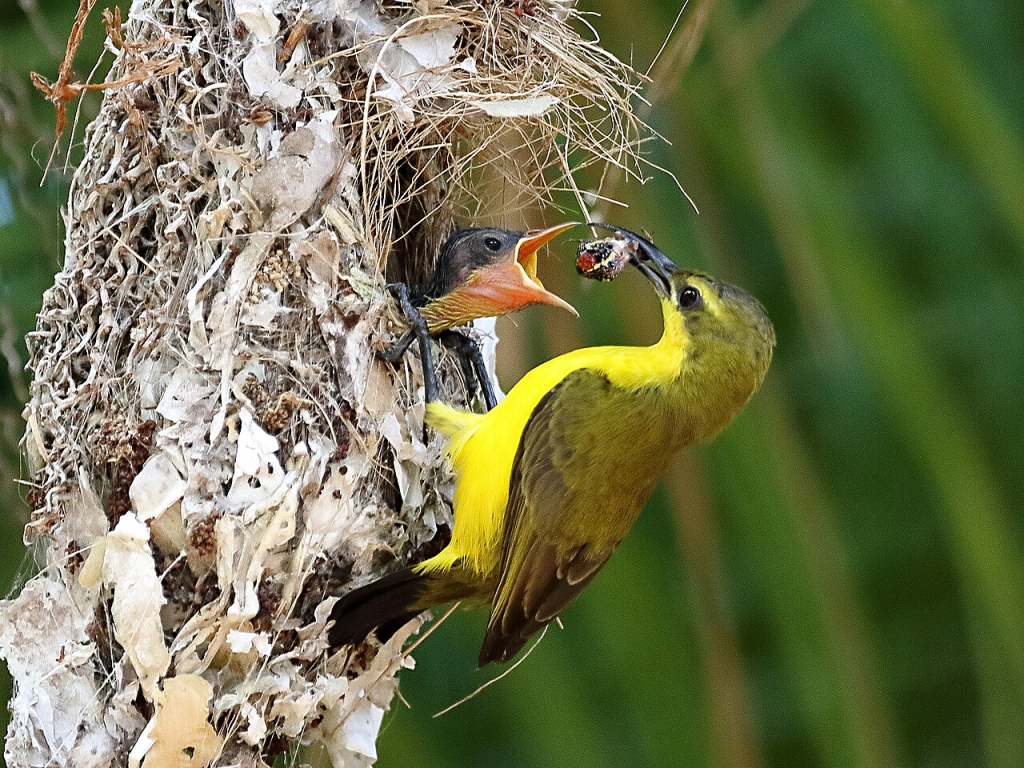
Birds eat insects for protein, fats, vitamins, minerals, and plenty of energy, making them an important part of many birds’ diets. Insects are also relatively easy to catch, widely available, and occur in a variety of habitats and seasons. Insect-rich meals, such as those listed below, become especially important when parents are feeding their young.
Caterpillars
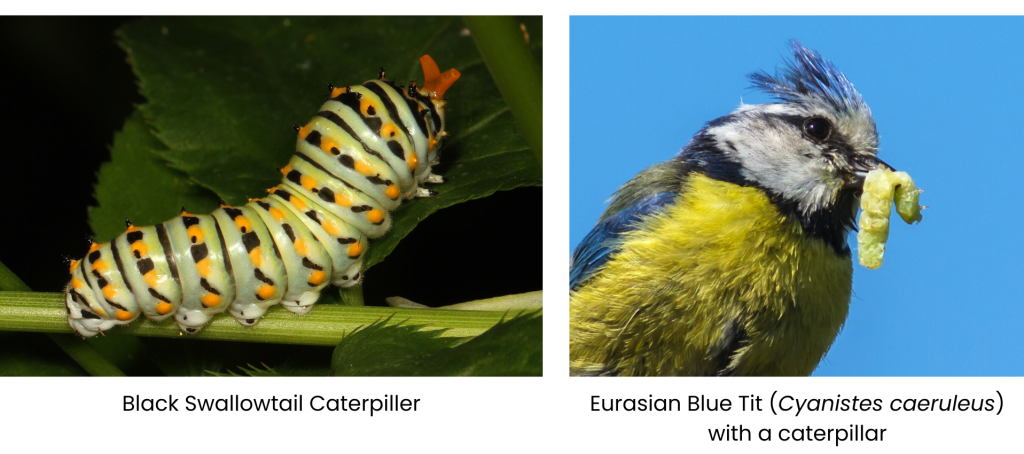
Caterpillars are the larval stage of butterflies and moths, spending most of their time eating and growing. Their soft bodies usually have three pairs of true legs and several fleshy prolegs that help them grip leaves and branches. Most species feed on leaves, while some consume flowers, fruits, seeds, or other insects. As a caterpillar grows, it sheds its skin several times, with each stage called an instar.
Caterpillars are an important food source for birds, especially during breeding seasons when nestlings need protein-rich meals. Insect- eating birds such as chickadees, blue tits, warblers, wrens, robins, sparrows, and flycatchers regularly feed caterpillars to their young. In North America, chickadees can collect hundreds of caterpillars while raising a single brood. To avoid predators, some species blend with leaves or twigs, while others use bright warning colours, hairs, spines, or chemical defences. By transferring energy from vegetation to birds and other predators, caterpillars form an important link in many terrestrial food webs.
Beetles
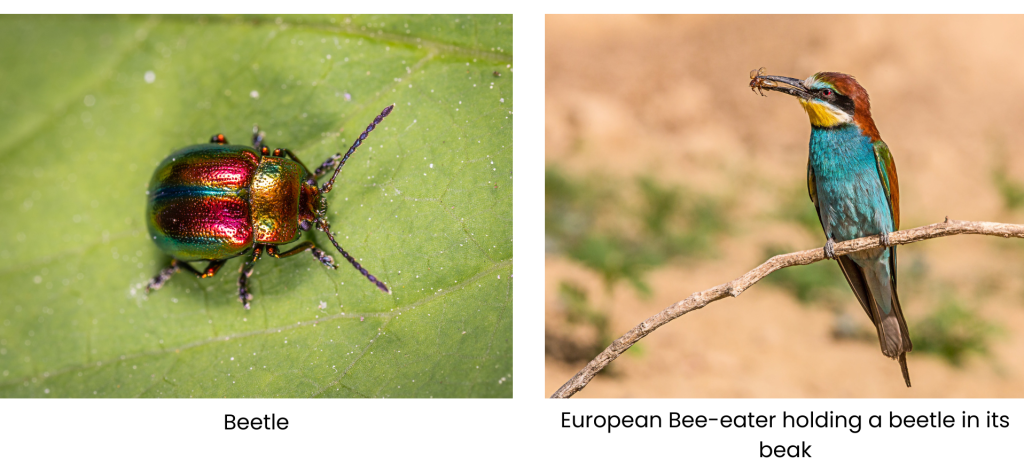
Beetles, belonging to the order Coleoptera, form the largest order of insects, with around 400,000 described species. Their hardened forewings, called elytra, protect the abdomen and hindwings, while three pairs of legs, antennae, compound eyes, and chewing mouthparts complete their basic body structure. They vary greatly in size, shape, colour, and body form among species. Beetles occur on every continent except Antarctica and occupy a wide range of habitats, including forests, grasslands, deserts, freshwater environments, coastal areas, and alpine zones. Beetles undergo complete metamorphosis, passing through four stages: egg, larva, pupa, and adult. The larval stage varies considerably among groups. Depending on the species, they may feed on leaves, flowers, roots, wood, fungi, decaying matter, or other insects. Their larvae may live in soil, roots, wood, beneath bark, or leaf litter. Adults and larvae occur at different times of the year depending on temperature, habitat, and food availability.
Both adult beetles and their larvae can become food for birds. Insect-eating birds find beetles on vegetation, tree trunks, beneath bark, and across the ground. Woodpeckers, bluebirds, cardinals, nuthatches, and starlings feed on beetles or their larvae. Some beetles, however, produce unpleasant chemicals or other defensive substances that deter predators. A fascinating detail is that beetle larvae can look completely different from adults, often resembling soft-bodied grubs before developing into winged adults. By feeding on plants, fungi, decaying material, or other insects and becoming prey for birds, beetles play important roles in decomposition, natural pest control, nutrient cycling, and food webs.
Grasshoppers
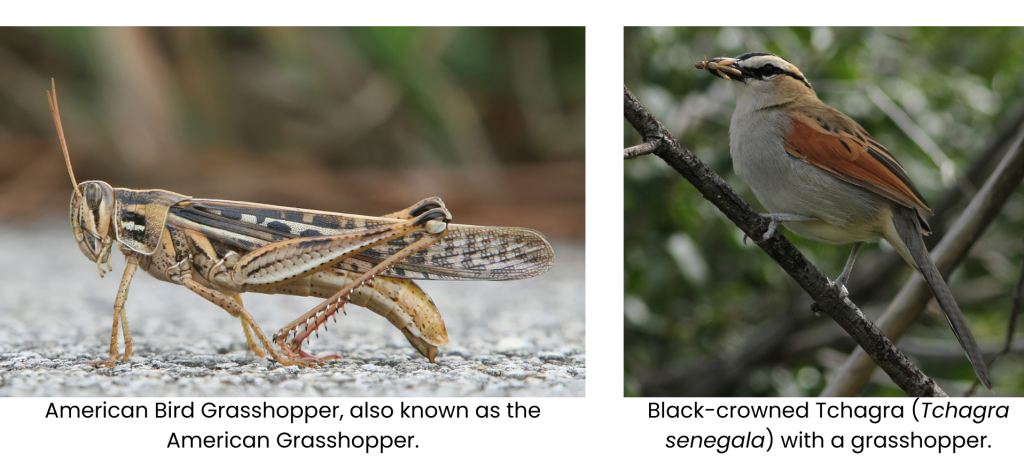
Grasshoppers are familiar insects with powerful hind legs, short antennae, two pairs of wings, and strong chewing mouthparts. Most measure around 2–7 centimeters and have green, brown, or grey bodies that blend easily with vegetation. They mainly eat grasses, leaves, flowers, and other plant material. They commonly occur in meadows, grasslands, crop fields, scrublands, and woodland edges, especially during warm weather. Grasshoppers occur across Africa, Asia, North America, Australia, and many other regions. Some species can become agricultural pests when their populations grow rapidly.
These insects are also an important food source for birds. Kestrels, starlings, mynas, shrikes, rollers, bee-eaters, lapwings, and meadowlarks regularly hunt grasshoppers. In some grassland ecosystems, a single bird may capture numerous grasshoppers. A fascinating detail is that grasshoppers can detect approaching predators through vibrations and respond with sudden, powerful jumps. Their hind legs can launch them rapidly away from danger, sometimes followed by short bursts of flight. Female grasshoppers lay eggs in soil, while young nymphs gradually develop adult features through several moults. By feeding on plants and serving as prey for birds, grasshoppers form an important link between vegetation and the broader food web.
Flies
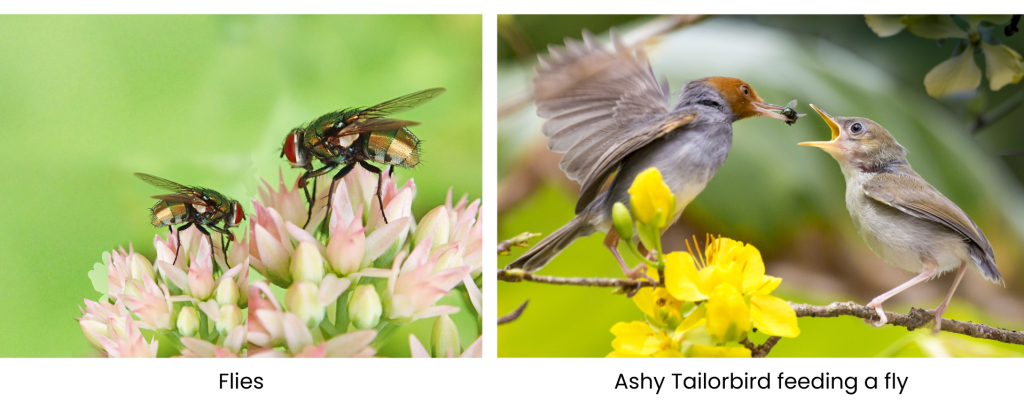
Flies are insects belonging to the order Diptera. They have one functional pair of wings, while their hindwings develop into small, club-shaped structures called halteres that help maintain balance during flight. Most flies measure between 2 and 12 mm in length, although their size varies greatly among species. Flies are among the most widespread groups of insects and occur on all continents, with their greatest diversity in tropical regions. They have adapted to diverse habitats, including tropical rainforests and arid deserts. Some fly larvae, including mosquito and phantom midge larvae, live in freshwater habitats, while certain adult midges occupy coastal lagoons, tidal rock pools, and shallow marine bays. Some species, such as the housefly, occur across the world. Flies undergo complete metamorphosis, passing through four stages: egg, larva, pupa, and adult.
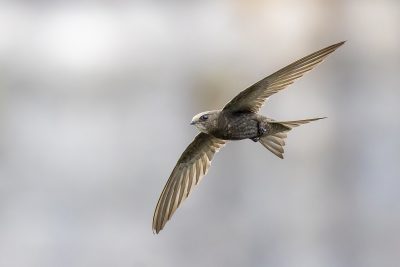
Adult flies are an important food source for many insect-eating birds, particularly flycatchers, swallows, swifts, and martins. These birds may catch flies in mid-air, pick them from vegetation, or capture them around water and other insect-rich areas. During the breeding season, parent birds also collect flies and other small insects to feed their young. A fascinating detail is that flycatchers can launch from a perch, catch a flying insect, and return to the same perch in seconds. While people often consider flies pests, many species also pollinate plants, break down organic matter, and provide an important link between insects and birds in the food web.
Crickets
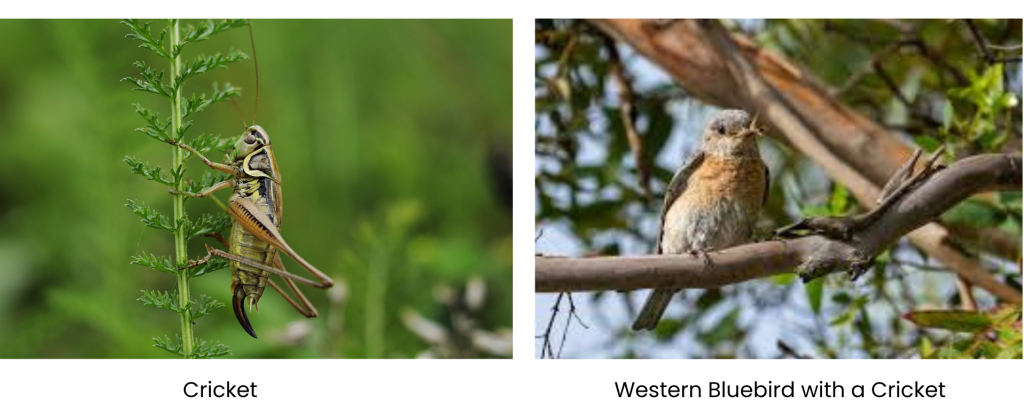
Crickets are small, mostly nocturnal insects known for their long antennae, rounded bodies, strong hind legs, and familiar nighttime chirps. Most species live among grass, leaf litter, gardens, fields, and woodland edges, where they feed on plant material, fungi, and small insects. Their brown or dark bodies help them blend into soil and vegetation, keeping them difficult to spot. This hidden lifestyle does not keep them away from predators, however, and crickets become valuable prey for many insect-eating birds. Robins, thrushes, mynas, starlings, kingfishers, owls, and wrens regularly hunt them, with some species searching through leaves while others catch exposed insects from the ground. Young crickets hatch as nymphs and gradually develop adult features through several moults. Beyond birds, frogs, lizards, spiders, and small mammals also eat them. This makes crickets an important link between vegetation, smaller organisms, and the predators that depend on them.
Cicadas
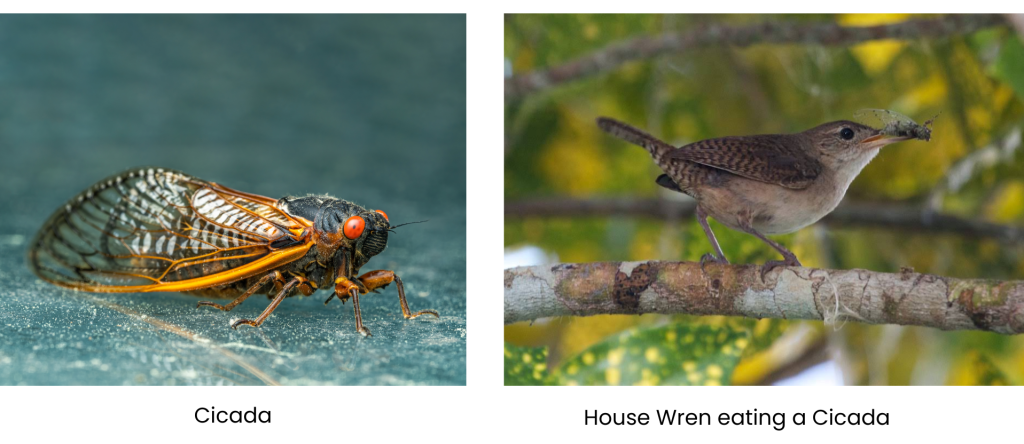
Cicadas are medium to large insects, generally measuring 2–5 cm. They have short antennae, two pairs of transparent wings, prominent compound eyes, and three simple eyes called ocelli. Their mouthparts allow them to suck plant sap, so they do not bite or sting. Males produce their characteristic loud calls using specialised structures called tymbals near the base of the abdomen. They have three main life stages: egg, nymph, and adult. Cicadas occur in tropical and temperate regions worldwide. They occur in a variety of habitats, including forests, grasslands, and deserts, with different species occupying distinct geographic ranges. The season in which cicadas appear varies among species. Periodical cicadas emerge in spring every 13 or 17 years, while annual cicadas emerge each summer and generally have life cycles lasting 2–5 years.
Several insect-eating birds consume cicadas, including American robins, blue jays, woodpeckers, American crows, hawks, and owls. These birds take advantage of cicadas as a nutritious, high-protein food source, particularly during large emergence events. Periodical cicadas rely on predator satiation as a survival strategy, emerging in huge numbers so that birds and other predators cannot consume the entire population. Cicadas also have specialised wing nanostructures that reduce light reflection, helping them remain less visible to predators. Although people generally do not consider cicadas pests, large numbers of females can damage young saplings during egg-laying. Beyond their loud songs, these insects play a crucial role in the ecosystem and serve as an important food source for many animals.
Termites
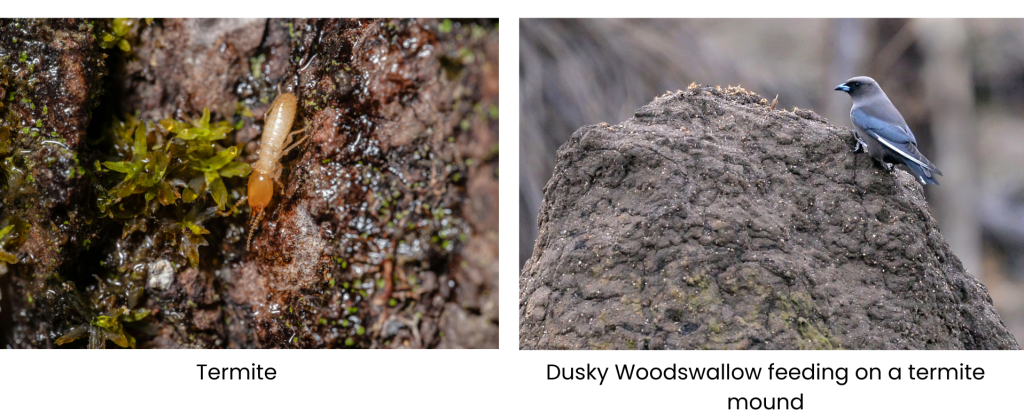
Termites are small social insects with soft bodies, straight antennae, and strong jaws. They usually live in colonies beneath soil or inside wood, feeding mainly on dead wood, fallen leaves, grass, and other cellulose-rich material. Microorganisms in their digestive systems help break down cellulose, making termites important decomposers. They are common across tropical and subtropical Africa, Asia, Australia, and South America, with some species also found in warmer parts of North America. Colonies contain workers, soldiers, and reproductive adults, each performing different tasks.
For birds, termites become especially valuable during nuptial flights, when winged reproductive termites leave established colonies in large numbers. Woodpeckers, hoopoes, hornbills, bee-eaters, starlings, mynas, and swallows may gather around these insects. Some birds catch them in the air, while others pick them from the ground after landing. Hoopoes and woodpeckers may also search soil or decaying wood for hidden termites. This sudden abundance can provide birds with an easy seasonal food source. Termites therefore connect underground decomposition with above-ground food webs. After mating, winged termites shed their wings and begin new colonies. Although some species damage wooden structures, termites remain valuable in natural ecosystems. They recycle nutrients, break down dead vegetation, and provide food for birds, reptiles, amphibians, spiders, and small mammals.
Mayflies
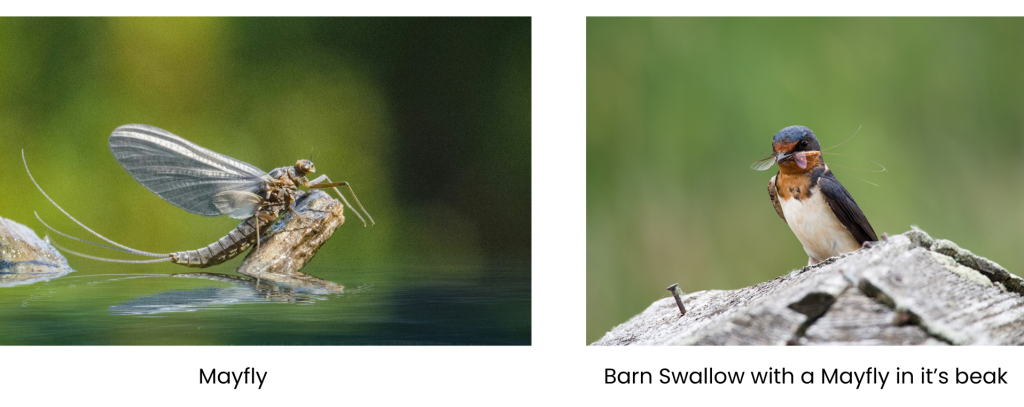
Mayflies are delicate aquatic insects belonging to the order Ephemeroptera. Adults have large compound eyes, two pairs of membranous wings, and usually two or three slender tails. Their adult mouthparts are nonfunctional, so they do not feed during the winged stages. Mayflies occur on all continents except Antarctica, with more than 2,500 species known worldwide. Their immature nymphs live mainly in freshwater environments such as streams, rivers, and ponds, while a few species can tolerate brackish water in marine estuaries. Mayflies have four life stages: egg, nymph, subimago, and adult. Females lay eggs in water, where they hatch into aquatic nymphs.
Mayflies often emerge in large numbers during summer. Insect-eating birds such as swallows, swifts, eastern kingbirds, and tree swallows, along with bats and predatory insects, eat adult mayflies. Fish and aquatic invertebrates feed on their nymphs. Mayflies do not directly damage plants because adults cannot feed, while their aquatic nymphs primarily contribute to freshwater food webs rather than feeding on terrestrial vegetation. Mayflies are vital parts of freshwater ecosystems, supporting food webs and energy transfer.
Dragonflies
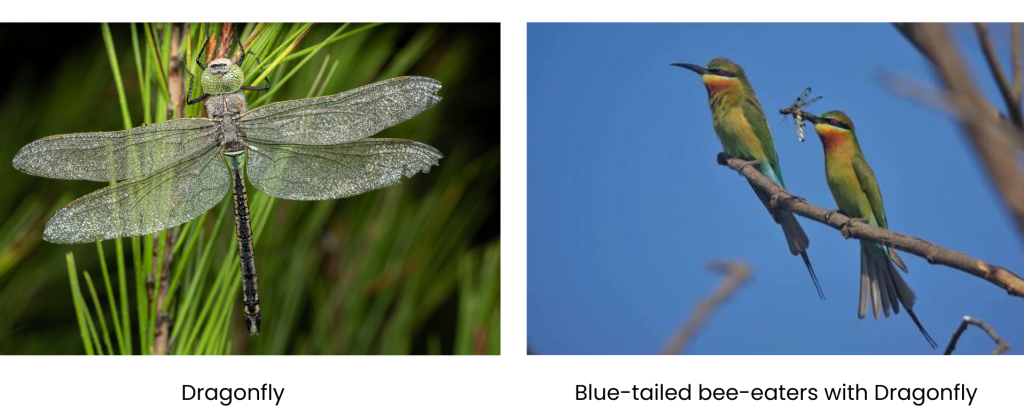
Dragonflies are predatory insects in the suborder Anisoptera within the order Odonata. They have long, slender abdomens, large compound eyes, short antennae, and two pairs of transparent, intricately veined wings. Their hindwings are broader than their forewings, and unlike damselflies, they usually hold their wings horizontally when resting. Many species show striking blue, green, yellow, red, brown, or black colours. Their powerful flight allows them to hover, glide, accelerate, and change direction rapidly. Dragonflies occur on every continent except Antarctica, particularly around ponds, lakes, streams, rivers, marshes, and other freshwater habitats. Some species also occur in desert pools and at high elevations. Adults are most active during warm periods, while their aquatic nymphs can live in freshwater for several months to several years.
Birds such as falcons, nighthawks, swifts, flycatchers, swallows, and hobbies eat dragonflies. Aquatic birds and other predators, including ducks and herons, also feed on their nymphs.
Dragonflies are important freshwater predators that connect aquatic and terrestrial ecosystems. Their dependence on clean, suitable water habitats also makes them valuable indicators of environmental health.
Aphids
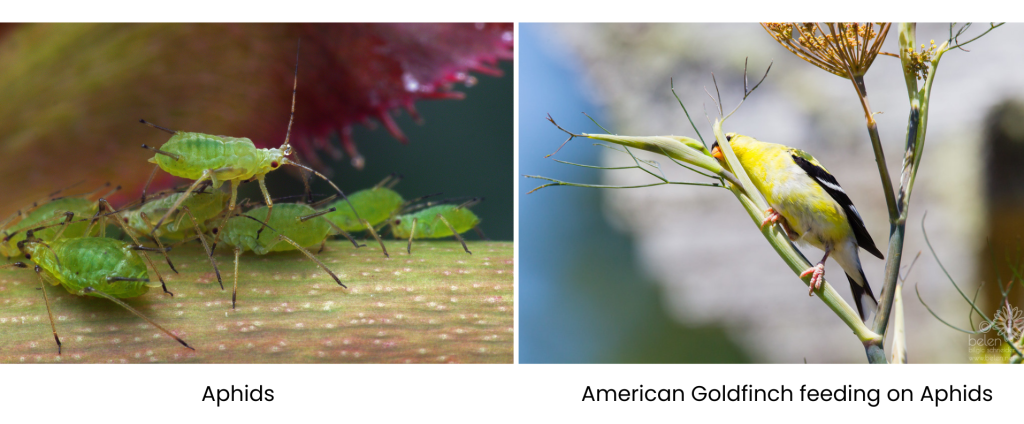
Aphids are tiny, soft-bodied insects often found clustered on young stems, leaves, and flower buds. They can be green, black, yellow, brown, red, or grey, depending on the species. Most feed by drawing sap from plants, allowing colonies to grow quickly when conditions are favourable. They occur in gardens, farms, forests, grasslands, and urban landscapes across much of the world. Their small size makes them easy prey for several predators, including ladybirds, lacewings, hoverfly larvae, and parasitoid wasps.
Chickadees, tits, warblers, sparrows, and wrens regularly pick aphids from leaves and stems. Parent birds may collect large numbers of these soft-bodied insects because they are easy for nestlings to swallow. During spring and early summer, aphids can become part of the available insect supply. Aphids reproduce rapidly, and some species produce winged individuals when crowded or when plants become unsuitable. Although large infestations can weaken plants and transmit plant diseases, aphids remain an important link between vegetation and the animals that depend on small insects for food.
The next time you see a bird carrying an insect, look twice. That tiny meal may head straight to a nest, where it can provide the energy a growing chick needs to survive, develop, and eventually take flight. A caterpillar on a leaf or a grasshopper in the grass may be part of a much bigger food chain than it appears. By protecting insect-rich gardens and natural habitats, we also help provide birds with the food they need. Sometimes, keeping the smallest creatures around is one of the best ways to support the birds we love.
Frequently Asked Questions
Insects provide birds with protein, fats, vitamins, minerals, and energy. They are especially important when parent birds are feeding growing nestlings.
Birds eat a wide variety of insects, including caterpillars, beetles, grasshoppers, flies, crickets, cicadas, termites, mayflies, dragonflies, and aphids. The insects eaten vary by bird species, habitat, season, and availability.
Birds use their eyesight and foraging behaviour to search leaves, branches, bark, soil, and leaf litter for insects. Some species also specialise in searching particular habitats or surfaces for prey.