Overview
Ceylon Slitwort is a hardy flowering herb with a long history of traditional use. It grows naturally across several tropical and subtropical regions. It is widely distributed across India, the Philippines, and the plains of Mauritius, Réunion Island, and Java. It is valued for its traditional uses in medicine and agriculture.
Regional Names
Ceylon slitwort has different regional names across its natural range. In India, people commonly call it Thumba or Thumbai, among other regional names. In Sanskrit, it is called Dronapushpi. In the Philippines, people use names such as Pansi-pansi and Karukansoli in Tagalog, as well as Paysi-paysi in Bisaya. Meanwhile, people in Indonesia know it as Ngangegan in Javanese.
Characteristics
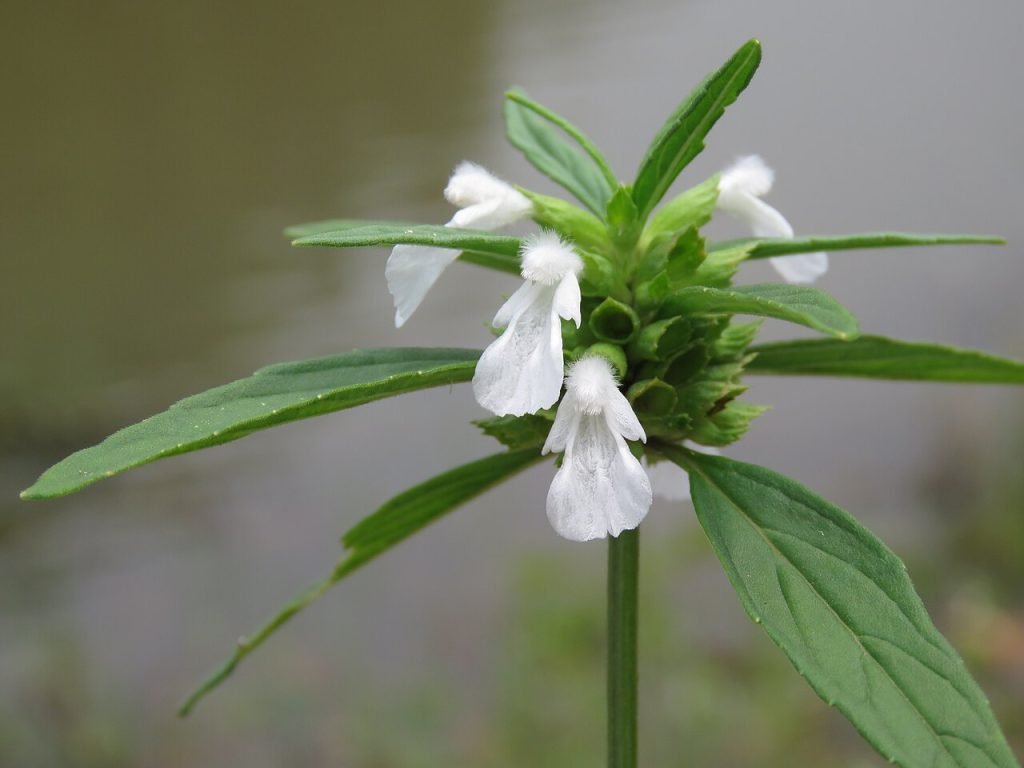
Ceylon slitwort is a branched annual herb or undershrub that grows up to about 1.3 feet tall. Its roots are shallow and fibrous, spreading through the soil to absorb available water. The stem is green, quadrangular in cross-section, well branched, and covered with fine hairs. Its leaves are narrow and lance-shaped, with no petiole or a very short petiole. They are about 8–12 cm long, with slightly hairy surfaces and serrated margins. The small, distinctive white flowers occur in umbrella-like whorls at the nodes.
Each flower has an upper and lower lip. The lower lip spreads outward, while the upper lip curves upward. The flowers are tubular at the base and measure about 1–2 cm long. Ceylon slitwort flowers during spring and summer and may become covered with white blooms. After pollination, the plant produces small nutlets measuring about 1–2 mm long, each containing a seed. The plant reproduces through seeds.
Growing Ceylon Slitwort Plant
Ceylon slitwort is a hardy plant that can grow in backyards, vacant plots, roadsides, and even small cracks in pavements. It grows best in good sunlight for most of the day but can also tolerate partial shade beneath larger trees. As a wild plant, Ceylon slitwort can tolerate poor soil conditions and some degree of waterlogging. It generally emerges during the rainy season and requires little additional watering or maintenance. As an annual, it grows, flowers, produces fruits, and completes its life cycle by the peak of summer. Its seeds remain dormant in the soil until the next rains. When the rains return, they germinate and produce new plants.
Ceylon Slitwort and Onam
Ceylon slitwort, known locally as Thumba or Thumba Poo, has a special connection with Onam in Kerala. People traditionally use its small white flowers to create pookalams, the floral carpets made during the festival. Thumba flowers traditionally sit at the center of the pookalam, often along with a tulsi leaf. In some regions, people make the first-day Atham pookalam mainly or entirely with Thumba flowers.
The flower also decorates the idol of Thrikkakara Appan during Onam celebrations. Therefore, it holds significance beyond decorative use. It connects with Kerala’s traditional Onam customs and floral arrangements.

Uses of Ceylon Slitwort Plant
Ceylon slitwort has a long history of traditional use in Ayurveda, Siddha, and other forms of herbal medicine. People have traditionally used different parts of the plant for conditions such as fever, intestinal worms, respiratory illnesses, sores, wounds, gastric problems, and skin ailments. Traditional practices have also used it for snake and scorpion bites. People use the leaves in cooking and traditional preparations. It also serves as a natural insecticide. Its reported antifungal and antimicrobial properties have further contributed to its traditional applications. Although commonly considered a weed, Ceylon slitwort is a versatile herb with a long history of traditional use in medicine, cooking, and other preparations.
Frequently Asked Questions
Yes. It commonly grows along roadsides, vacant plots, and other disturbed areas, so it is often considered a weed. However, its traditional uses and cultural importance make it more than an ordinary unwanted plant.
Ceylon slitwort usually emerges during the rainy season. It grows, flowers, and produces seeds before completing its annual life cycle, while its seeds remain dormant until the next rains.