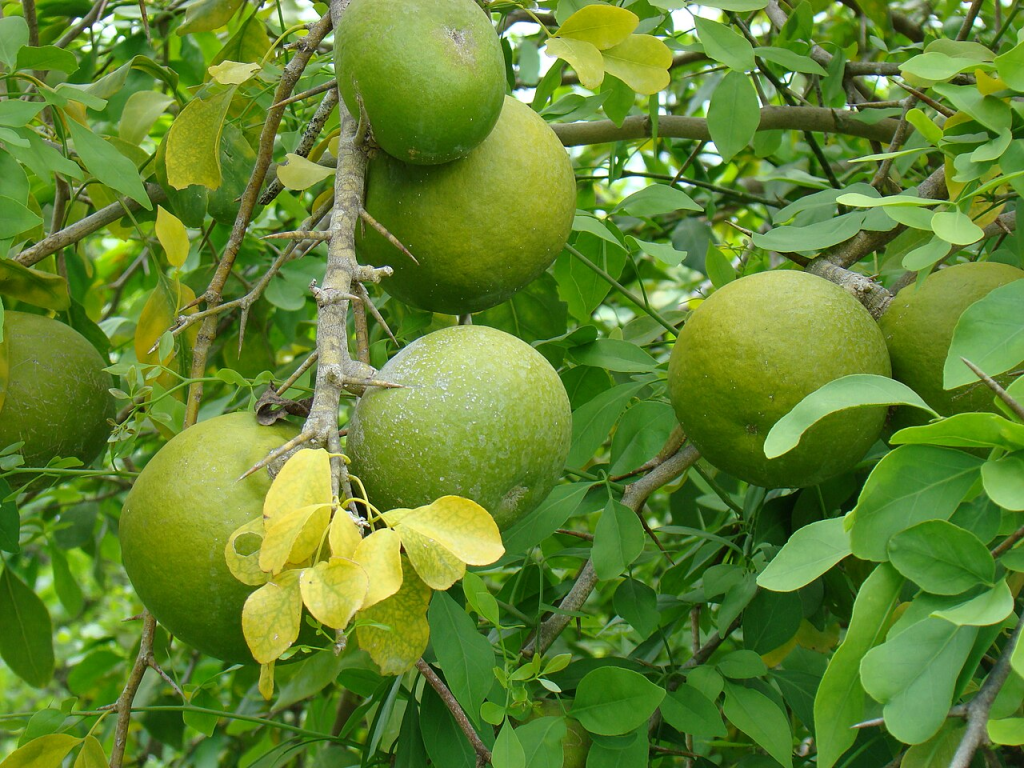
The Trifoliate Leaves and Hard Fruit
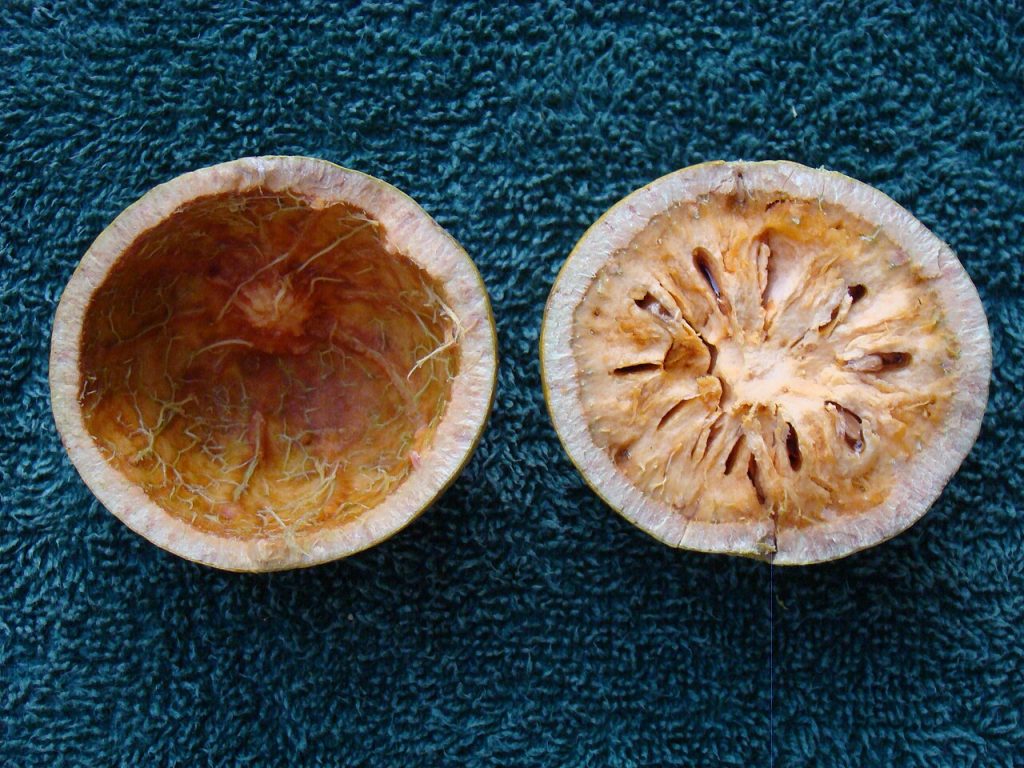
Bael is a medium-sized deciduous tree that belongs to the family Rutaceae (citrus family). It usually grows to about 10 meters in height and has a thick trunk with grayish, slightly wrinkled bark. Young branches may have sharp axillary spines, which are a useful identifying character. Its leaves grow alternately along the branches and usually have three leaflets, giving the foliage a characteristic trifoliate appearance. Leaflets are ovate to elliptic, smooth, and mostly pointed toward their tips. The fragrant flowers develop in axillary or terminal clusters and generally bloom during the warmer months. Inside the flowers, several stamens surround the reproductive structures in the middle. The bael fruit is big and globose or oval in shape with a hard, woody shell. The aromatic pulp within the shell ranges from orange to reddish and contains many flattened seeds covered with mucilaginous material.
Occurance
One of the odd things about trees in the citrus family is that they have a hard fruit shell, and Bael is closely related to citrus. However, its trifoliate leaves resemble those of several unrelated plant groups.
The species is indigenous to the Indian subcontinent and occurs throughout India, Nepal, Bangladesh, Pakistan, and the Western Himalayan region. It occurs in deciduous forests, dry woodlands, open plains, hills, temple gardens, and household gardens. Bael offers food, shade, habitat, cultural value, and plant diversity to the landscapes it inhabits.
Names of Bael in Different Languages
Bael is known by many names across the Indian subcontinent and Southeast Asia. In English, common names include bael, bael fruit, Indian bael, Bengal quince, Indian quince, golden apple, elephant apple, stone apple, wood apple, and Japanese bitter orange. Some of these names can overlap with other species, particularly “wood apple,” so the scientific name Aegle marmelos is useful for precise identification.
In India, the tree is known as Bel or Bael. Other regional names include Bilva or Shreephal in Sanskrit; Vilvam, Vilva maram, or Vilva pazham in Tamil; Maredu in Telugu; Bel in Bengali and Urdu; Kaveeth in Marathi; and Koovalam in Malayalam. It is also known as Belada Hannu in Kannada, Beli in Sinhala, and Gudu in Nepali.
Beyond India, names include Matum or Mapin in Thai, Mojo in Javanese, Pokok maja batu in Malay, Trai mam or mbau nau in Vietnamese, Banu in Khmer, and Toum in Lao.
Bael’s Seasonal Adaptations
Bael is adaptable to a wide range of soil conditions and can tolerate seasonal drought after establishment. It is a deciduous tree, so it drops its leaves in dry periods, reducing its water needs. The fragrant flowers may attract visiting bees and other insects for floral resources. Fruits are food resources for animals that eat pulp and then disperse seeds. Bael prefers warm climates, sunlight, well-drained soil, and a distinct dry season for regular fruit production. Plants can reproduce through seeds, while growers can also propagate cultivated plants through vegetative methods.
Cultural Significance of Bael
Bael has a long-standing cultural and religious association with Hindu traditions. Hindus regard bael as one of their sacred trees, and they use its leaves in religious rites. The tree has a strong association with Lord Shiva, and devotees use its leaves and fruits in his worship. Traditionally, people interpret the three-part leaf as a representation of Shiva’s trident, while another belief associates the three leaflets with his three eyes. People commonly grow bael trees near Hindu temples and in home gardens.
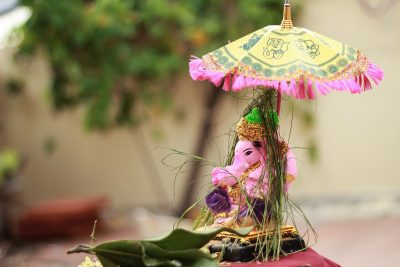
The religious associations of bael extend beyond its connection with Shiva. Early evidence of the plant’s religious importance appears in the Sri Sukta of the Rigveda, which associates the plant with Lakshmi, the goddess of wealth and prosperity. Hindu traditions also associate bael trees with the goddess Sati. Furthermore, devotees use bael leaves in Ganesh pooja as one of the 21 sacred offerings. In the traditional Patrapuja, or worship with leaves, devotees offer bel among the leaves to Lord Ganesha and associate it with devotion, protection, and the removal of obstacles. This makes bael leaves an important element of traditional worship during Ganesh Chaturthi.
Bael also has cultural importance in Buddhist and Newar traditions. Among the Newar people of Nepal, the bael fruit plays an important role in Bel Bibaaha, a traditional ritual in which girls symbolically marry a bael fruit. The fruit also appears in the Buddhist Daddabha Jataka, where the Buddha tells an early version of a story involving a hare frightened by a fruit falling onto a palm leaf.
Uses of Bael
Medicinal Uses of Bael
Many people have used different parts of the bael plant, including the leaves, bark, roots, fruits, and seeds, in traditional medicine. Ayurvedic practitioners and other traditional Indian systems have incorporated different parts of the plant into preparations for various ailments. Traditionally, people have used the fruit, particularly unripe fruit, for digestive complaints, including diarrhea and dysentery.
Modern research has investigated the plant’s phytochemicals, including alkaloids, coumarins, flavonoids, phenolic compounds, and tannins, as well as their biological activities. Studies have reported antioxidant, antimicrobial, antidiarrheal, and other pharmacological activities, but much of the evidence comes from laboratory or animal studies. These findings show potential but do not prove that bael can treat or cure diseases in humans.
Culinary Uses
The fruit of bael is edible and used both fresh and in processed forms. People can eat the ripe pulp fresh, while processors can dry the fruit and make products such as candy, toffee, pulp powder, nectar, preserves, jam, syrup, and other food products. In India, people commonly use bael to prepare bael sherbet or bela pana, a drink made by extracting and sweetening the fruit pulp.
People also use bael fruit in traditional food preparations in other parts of South and Southeast Asia. In Indonesia and Thailand, people consume ripe fruit and sliced fruit as food, while they may use bael-based syrups in food preparation. Its nutritional composition and phytochemicals have also attracted interest in food processing and functional-food research.
Frequently Asked Questions
Bael is also known as bel, bilva, Bengal quince, Indian quince, golden apple, elephant apple, and stone apple.
Yes. Bael fruit is edible and can be eaten fresh or processed into products such as pulp, powder, candy, nectar, syrup and traditional drinks such as bael sherbet.