A Striking Appearance
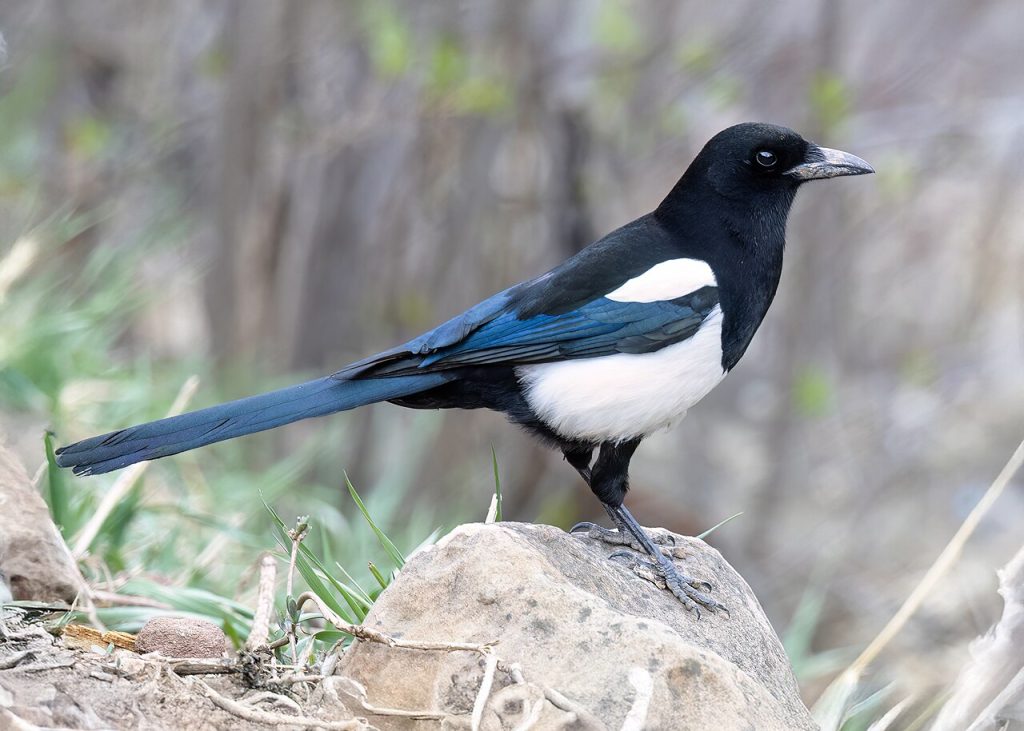
The Black-billed Magpie is easy to spot because of its striking black-and-white feathers, long tail, and graceful flight. The Black-billed Magpie is mainly black with large white patches on the outer part of its wings and white feathers along the shoulder area where the wings join the body. The underside of each wing is also white.
The black feathers on the wings and tail shimmer with metallic shades of blue, green, or purple when viewed from different angles in the light. Male and female magpies look alike, and their plumage changes very little throughout the year. Juveniles resemble adults but have less glossy feathers and duller black-and-white coloring.
Voices of the Magpie
The Black-billed Magpie has a wide range of vocal sounds. It uses harsh chattering alarm calls to warn other birds, animals, and even humans of nearby predators. It also produces long, complex, song-like vocalizations. These are different from the songs of most songbirds.
Life Across Open Landscapes
Black-billed Magpies thrive in a variety of habitats, including both undeveloped and developed areas. They prefer open places with plenty of shrubs or trees nearby. They commonly live in grasslands, farmland, rangelands, grain storage areas, and dumps. Their nests are usually built in dense bushes or vegetation near rivers and streams.
An Opportunistic Feeder
Black-billed Magpies eat a wide range of foods. Their diet mainly includes dead animals (carrion), seeds, beetles, and grasshoppers. It also includes fruits, bird eggs, baby birds, and leftover food from humans. They search for insects by turning over cow or bison dung and often feed on maggots found on dead animals. They also occasionally hunt small mammals such as mice and voles.
Social Lives and Remarkable Behavior
Black-billed Magpies are highly social birds that are commonly found in pairs or groups. They use loud alarm calls to warn other birds, animals, and even humans of nearby predators, such as foxes and cats. One of their most remarkable behaviors is gathering around a dead magpie. Dozens of birds call loudly for 10–15 minutes before silently dispersing. This behavior is often described as a funeral-like gathering.
Family Life and Nesting
During courtship, males perform display flights and chase females while showing off their white wing patches. The male and female work together to choose a nesting site and build the nest. Their nests are large, dome-shaped structures made of sticks, with a cup-shaped inner nest.
The female usually lays 6–9 eggs and incubates them alone for about two to three weeks, while the male regularly brings her food. The eggs are pale gray to olive-brown with dark spots. After hatching, both parents feed and care for the chicks. The chicks stay in the nest for three to four weeks before they are ready to fly. The parents aggressively protect their young, often with help from nearby magpies. This cooperative behavior is called mobbing.
Challenges for the Future
Black-billed Magpies face threats from habitat loss, pesticide exposure, and human persecution. The loss of riverside nesting habitats and the use of harmful chemicals have contributed to a gradual decline in their population. Conservation efforts focus on reducing pesticide use and protecting and restoring riparian habitats. These efforts provide safe nesting sites and support healthy magpie populations.