A Master of Migration
The Common Cuckoo is a long-distance migratory bird. It is best known for its unmistakable “cuck-oo” call and its remarkable breeding strategy of laying eggs in the nests of other bird species. It breeds across Europe, Asia, parts of the Middle East, the Himalayas, and South Asia before migrating to sub-Saharan Africa for the winter. Occasionally, it appears as a rare visitor outside its normal range.
Appearance and Identification
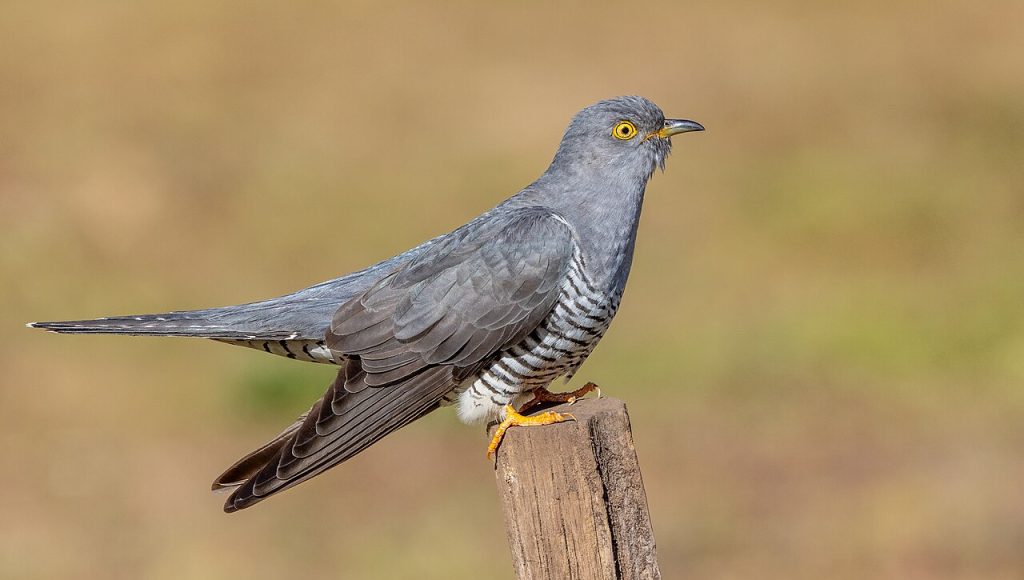
The Common Cuckoo is a medium-sized bird with a long tail, pointed wings, and short legs. It has a slender, slightly curved bill adapted for catching insects. The iris, eye-ring, base of the bill, and feet are yellow. Adult males are generally larger. They have slate-grey upperparts, a grey throat and breast, and white underparts marked with dark horizontal bars. Females are usually smaller and occur in two color forms: a grey morph similar to the male and a rufous (reddish-brown) morph with dark barring. Juveniles are brown to chestnut with white markings on the neck and wings.
Where it Lives, what it Eats
The species inhabits open and semi-open landscapes, including woodlands, scrublands, meadows, reedbeds, grasslands, and agricultural areas. It feeds mainly on insects, particularly hairy caterpillars, but also eats beetles, grasshoppers, dragonflies, spiders, and occasionally small snails, fruits, or the eggs and nestlings of small birds.
The Common Cuckoo is renowned for the male’s loud, two-note “cuck-oo” call, used during the breeding season to attract mates and defend territories. Females produce a rapid bubbling “kwik-kwik-kwik” call, especially during courtship. Each male has a distinctive call pattern, allowing individuals to be recognized by their vocalizations. During the non-breeding season in Africa, the species is generally quiet.
A Secretive Life
A solitary and secretive bird, the Common Cuckoo is usually seen alone except during the breeding season. Males call from exposed perches to establish territories, while females quietly search for suitable host nests. Its hawk-like appearance may help it approach nests unnoticed, although small birds often mob and chase it away once detected.
Master Trickster!
The Common Cuckoo is an obligate brood parasite, meaning it does not build its own nest. Instead, a female lays 10–25 eggs during a breeding season, placing one egg in each host nest after removing one of the host’s eggs. The host bird incubates the cuckoo’s egg for 11–13 days and unknowingly raises the chick. Shortly after hatching, the young cuckoo instinctively removes the host’s eggs or chicks from the nest, ensuring it receives all the food from its foster parents. It fledges after 17–21 days and remains dependent on the host for another 2–3 weeks before becoming independent.
Animated TV Appearance
Albeit as a part of the living room decor, the common cuckoo makes an appearance in the popular children’s cartoon, Peppa Pig. The cuckoo clock hanging in their living room has a cuckoo bird that heralds every hour with its distinctive call. In its own way, this bird is the centre stage of at least 2 episodes.
Challenges to its Future
The Common Cuckoo is classified as Least Concern by the IUCN due to its wide distribution and large global population. However, declines have been recorded in parts of Europe because of habitat loss, pesticide use, declining insect populations, climate change, and changes in the breeding schedules of host species. Conservation efforts focus on protecting insect-rich habitats, restoring wetlands and grasslands, reducing pesticide use, maintaining healthy host bird populations, and monitoring long-term population trends.