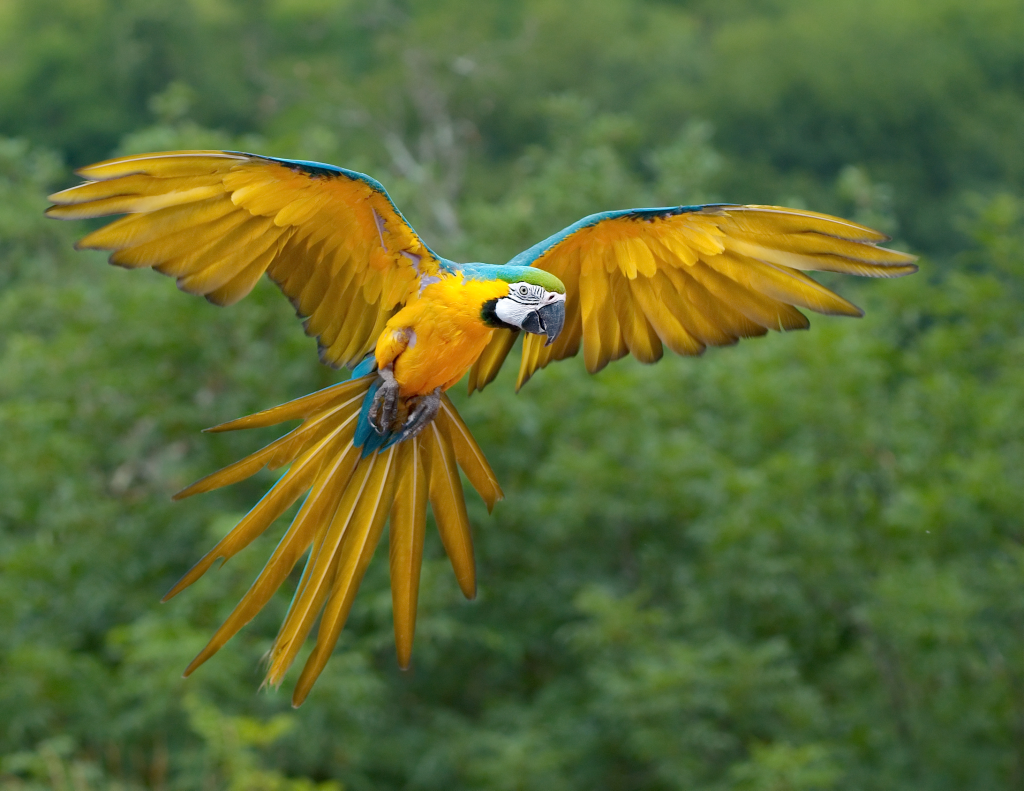
Yellow-and-blue Macaw is a large, brilliantly colored parrot with bright blue upperparts, bright golden-yellow underparts, green forehead, powerful black bill, and long graduated tail. Adults are typically between about 30 and 34 inches (75–86 cm) and weigh around 2–3 pounds (0.9–1.5 kg), making them one of the largest flying parrots in the Americas. A pale white face with fine black feather lines makes for a striking look, and strong zygodactyl feet grant excellent climbing skills. Its 104–114 cm (41–45 in) wingspan supports strong, steady flight between feeding and roosting sites.
Both male and female macaws have the same vibrant plumage, making them almost impossible to distinguish by appearance alone. Furthermore, as juveniles mature, their dark gray or brown eyes gradually change to yellow, and they develop their full adult coloration by about 3–4 months of age. Because the sexes look nearly identical, genetic testing is often required to determine their sex.
Diet and Feeding Habits
The blue-and-yellow macaw is a flexible omnivore that takes advantage of the diverse food resources available in its habitat. Yellow-and-blue Macaws eat mostly seeds, nuts, fruits, berries, flowers, and occasionally clay from exposed riverbanks. Scientists think the clay helps counter some naturally occurring toxins in plants and provides essential minerals. This species helps regenerate forests by dispersing seeds over large areas.
Breeding and Nesting Behavior
Natural populations occur in tropical rainforests, seasonally flooded forests, savannas, palm swamps, and river corridors throughout northern and central South America. They often nest in cavities of tall dead trees or in large living palms. Mutual preening, vocalizations, and synchronized movements are part of courtship practices that strengthen pair relationships before breeding.
Blue-and-yellow macaws reach sexual maturity between 3 and 6 years of age and form strong monogamous pair bonds. The female usually lays two or three eggs, and incubation lasts 25–28 days. Both parents share incubation duties, defend nesting sites, and feed regurgitated food until young birds are independent.
The chicks hatch blind, featherless, and helpless, remaining in the nest for several weeks while they develop. They fledge at 12–14 weeks but remain dependent on their parents for several more weeks. Typically, only 1–2 chicks normally survive to fledge, the stronger nestlings outcompeting the weaker ones.
Behavior and Social Life
The blue-and-yellow macaw is a highly social and vocal parrot, recognized by its loud calls that echo through the forest canopy. It is commonly seen in pairs, family groups, or flocks of 25 or more individuals.
Their roosting behavior changes with the breeding season. During nesting, mated pairs typically roost near their nesting sites, often in palm swamps or forested wetlands. Outside the breeding season, they gather in communal roosts, with hundreds of birds sharing a few tall trees.
Blue-and-yellow macaws spend much of the day foraging in the forest canopy, moving between trees in close-knit pairs. Additionally, at the first sign of danger, they communicate with loud alarm calls and take flight together, relying on their keen awareness, strong flight, and social coordination to avoid predators. Furthermore, predators include large raptors, arboreal mammals, and climbing snakes that can reach the nests.
Cultural Significance and Conservation
The blue-and-yellow macaw has long held cultural importance for Indigenous communities across Central and South America. Its striking appearance and loud, distinctive calls have inspired traditional stories, artwork, and symbolism among many native cultures. Moreover, the Tupi people of Brazil named the bird “ara”, an imitation of its loud calls that echo through the rainforest. They are extremely intelligent, vocalize with loud calls, form long-lasting pair bonds, and show impressive problem-solving skills.
Although the species is currently classified as Least Concern, habitat destruction, illegal trapping for the pet trade, and forest fragmentation and loss of nesting sites remain serious threats in portions of the species’ range. In some places, conservation success is achieved through protected reserves, better enforcement of wildlife trade laws, artificial nest programs, and habitat restoration.
Intelligence and Scientific Research
The Blue-and-yellow Macaw is one of the world’s most iconic parrots. Its intelligence, astonishing lifespan, ecological importance, and stunning plumage speak of the amazing diversity of tropical forest birdlife.