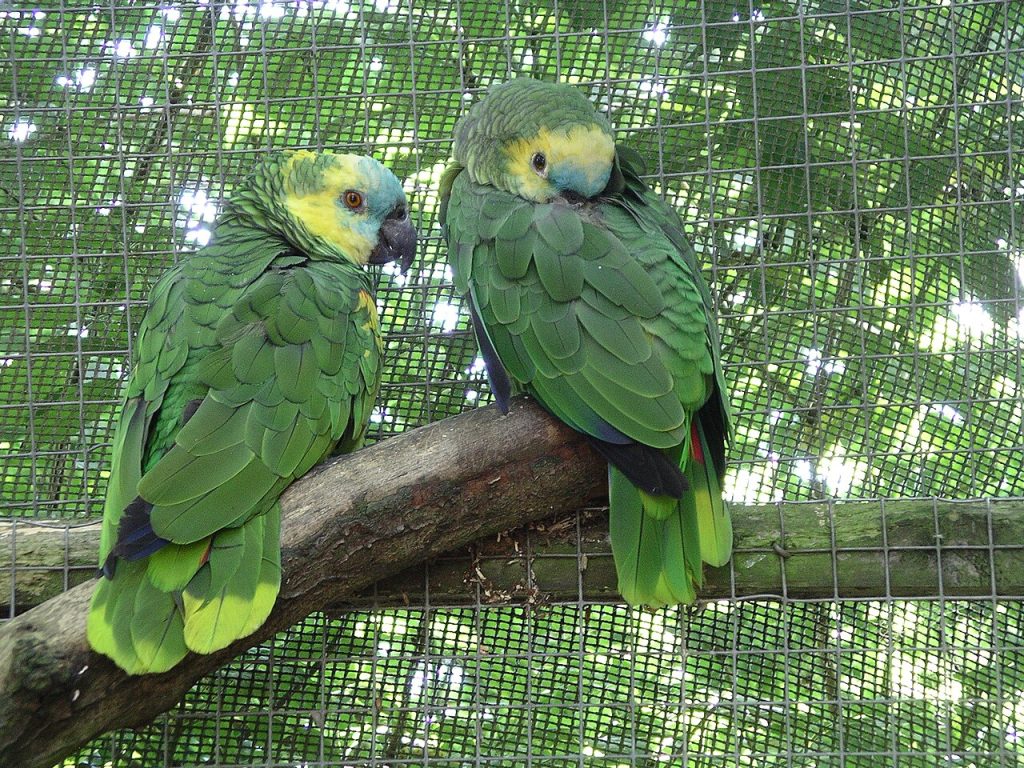
A Parrot of South American Forests
The Blue-fronted Amazon, also known as the Turquoise-fronted Amazon, is a vibrant parrot native to the wooded regions of Bolivia, Brazil, Paraguay, and Argentina. It is typically found in forests, woodlands, savannas, and gallery forests at low elevations, although in Bolivia it has been recorded at elevations of up to 5,200 feet (1,600 m).
Brilliant Colors and Bold Features
This medium-sized parrot is predominantly green, with a distinctive blue patch on the forehead above the bill. The extent of the blue varies greatly among individuals, from a small spot to nearly the entire head. Bright yellow feathers surround the blue area and extend across the face and crown, while vivid red feathers mark the bend of the wings. The tail is mainly green with red near the base, and the flight feathers may show subtle violet tones. Males and females look alike, making them difficult to distinguish by appearance alone. Juveniles are duller in color, with dark irises instead of the orange eyes seen in adults. The bill is black, and the feet are gray.
What Blue-fronted Amazons Eat
Blue-fronted Amazons are omnivorous, feeding mainly on fruits, seeds, nuts, berries, blossoms, and other plant material. They occasionally consume insect larvae and eggs, providing an additional source of protein.
Life in a Lively Flock
These parrots are highly social and intelligent. They gather in large flocks while feeding and roosting, which improves protection from predators, increases foraging success, and provides opportunities to find mates. Their loud calls help warn other flock members of approaching threats such as hawks and falcons. During the day, the flocks often divide into smaller groups, pairs, or family units while searching for food. In captivity, they are known for their playful nature and require regular social interaction and mental stimulation.
Raising the Next Generation
Blue-fronted Amazons nest in tree cavities, but they may also use cliff crevices or arboreal termite mounds. They form strong pair bonds before breeding. The female lays white eggs and incubates them for about 28 days, while both parents care for and feed the chicks. The young fledge at around 8–9 weeks of age.
Facing Challenges in the Wild
The Blue-fronted Amazon is classified as Near Threatened because of declining wild populations. The greatest threats are habitat loss from deforestation and capture for the illegal pet trade, both of which reduce breeding and feeding opportunities.
Conserving a Forest Icon
Conservation efforts focus on protecting and restoring forests, expanding protected areas, enforcing wildlife trade regulations, monitoring wild populations, and promoting responsible captive breeding. As a flagship species for South American forest conservation, the Blue-fronted Amazon helps raise awareness of the importance of preserving tropical forests, benefiting countless other species that share its habitat.
Animated Star!
The character of Polly Parrot in the popular kids’ show, Peppa Pig, is mostly based on the Blue-fronted Amazon. Fun Fact: Polly Parrot wasn’t created just for Peppa Pig. Her design was inspired by the parrot from Jolly Roger (1999), an animated short by Peppa Pig creators. That makes this Parrot twice famous!