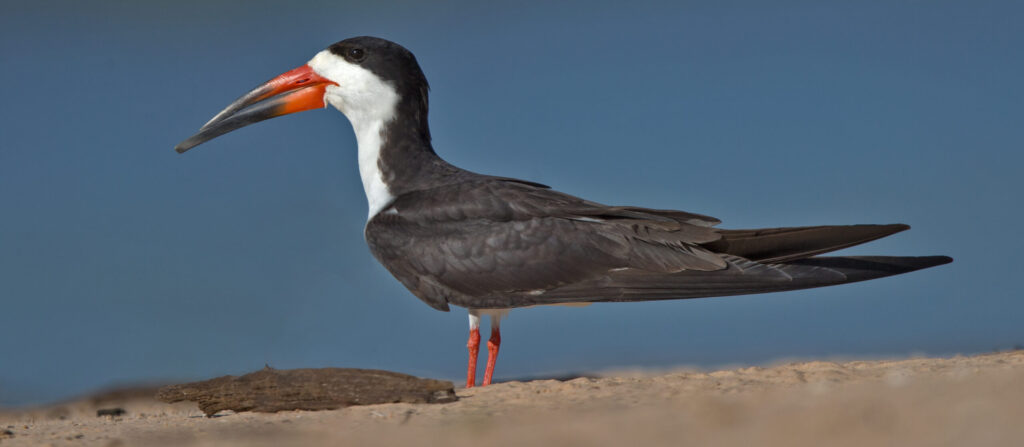
The Black Skimmer, with its striking black-and-white plumage, long wings, and uniquely shaped bill, it stands apart from other coastal birds. It is considered truly remarkable for its unusual method of feeding.
Adult Black Skimmers are medium-sized, tern-like seabirds measuring about 46 cm in length. They have black upperparts, white underparts, orange-red legs, and a black-and-red bill in which the lower mandible is noticeably longer than the upper. Juveniles are browner in appearance, with pale-edged feathers on their wings.
A unique feature is their eyes, which have vertical slit-like pupils that help reduce glare from water and sand. Their diet consists mainly of small fish, but also consume crustaceans, insects, and mollusks.
Technique specialized for capture
The skimmer’s feeding technique is one of the most specialized in the bird world. Flying just above the water’s surface, it lowers its elongated lower bill into the water while keeping the upper bill open. When the lower mandible touches a fish or other prey, the bill snaps shut instantly, capturing the animal.
Because this method depends on touch rather than sight, they can successfully forage during dawn, dusk, and even at night when many other birds are inactive. While others birds rely on sight, it uses touch, allowing it to hunt in darkness.
Skimmers are often seen feeding in groups, flying in graceful formations over calm coastal waters. Their flight style is distinctive, featuring long upstrokes and shorter downstrokes that keep them just above the water’s surface.
Sandy beaches to riverbanks. North to South America
Black Skimmers inhabit sandy beaches, barrier islands, estuaries, lagoons, marshes, riverbanks, and sheltered coastal bays. They are found throughout North and South America. Northern populations migrate to warmer regions during winter, including the Caribbean and tropical coastlines, while South American populations make shorter seasonal movements in response to changing water levels.
Togetherness among Black Skimmers
These birds are highly social and often gather in large flocks on sandbars and beaches. Their typical call is a sharp, barking “kak-kak-kak,” which can often be heard before the birds are seen.
During the breeding season, Black Skimmers form monogamous pairs and nest in loose colonies on sandy beaches or islands. Females usually lay three to five eggs in shallow scrapes in the sand, and both parents share incubation duties for about 21 to 23 days.
At hatching, young skimmers have upper and lower bills of equal length. As they grow, the lower mandible gradually becomes longer, developing into the specialized feeding tool of adults. Chicks leave the nest shortly after hatching and can fly within a few weeks.
Once threatened by egg collection and hunting for feathers, Black Skimmer populations have recovered in many areas. However, they remain vulnerable to habitat disturbance, coastal development, and climate-related changes. Their remarkable feeding strategy and elegant flight continue to make the Black Skimmer one of the most fascinating birds of coastal ecosystems.