Frequent Flyer of the Bird World
The Amur Falcon is a small but remarkable bird of prey famous for undertaking one of the longest migratory journeys in the avian world. Breeding in southeastern Siberia, northern China, and Mongolia, this species travels thousands of kilometers each year to spend the winter in southern Africa.
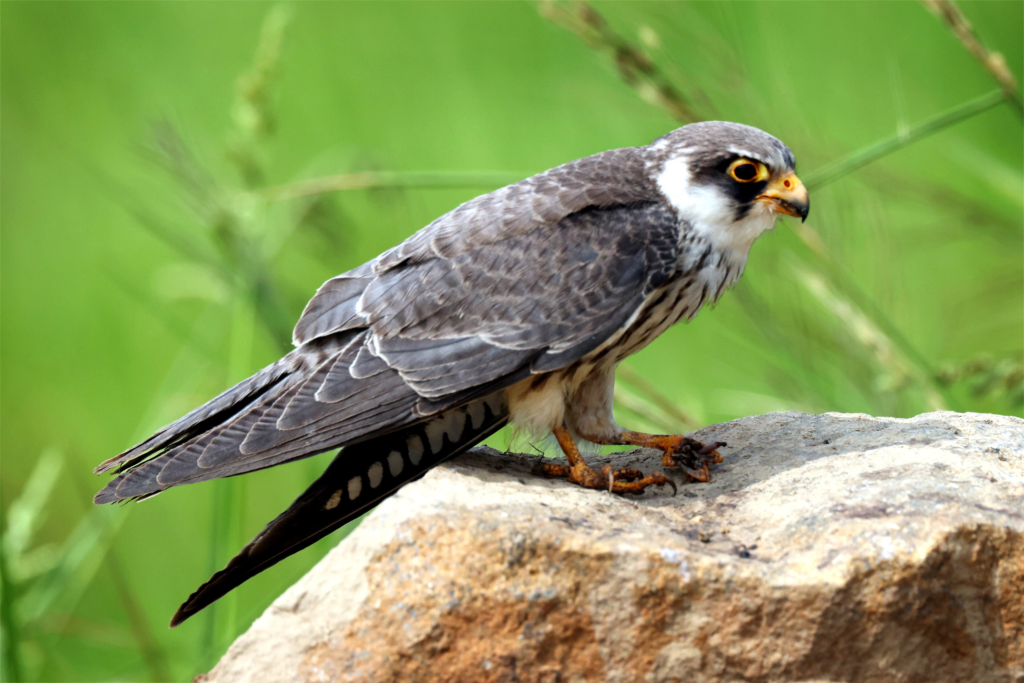
Measuring about 28–30 cm in length with a wingspan of 63–71 cm, the Amur Falcon exhibits noticeable sexual dimorphism. Adult males have sleek dark grey plumage, striking red legs, and a red cere at the base of the bill. Females are larger and display a contrasting appearance, with a white underbelly heavily streaked with rufous and black markings and a grey-brown back. Juveniles resemble females but have a more reddish-brown coloration and less distinct streaking.
The Insect Buffet Champion
Their diet consists mainly of insects such as termites, locusts, beetles, dragonflies, and ants. These falcons are agile aerial hunters capable of catching prey in flight, hovering briefly before striking, or picking insects from the ground. During the breeding season, they may also consume small vertebrates to provide additional nutrition for their chicks.
The Art of Second-Hand Real Estate
During the breeding season, Amur Falcons inhabit open woodlands, river valleys, and forest-steppe habitats where they can find abundant prey and suitable nesting sites. Unlike many birds, they rarely construct their own nests. Instead, they occupy abandoned nests built by crows, rooks, and other birds or use natural tree cavities.
The species is monogamous, with pairs forming during the breeding season. Females usually lay three to four eggs, and both parents share responsibility for incubation and feeding the chicks. The eggs hatch after approximately one month, and the young fledge around 30 days later.
Passport Stamped by Three Continents
The Amur Falcon is best known for its extraordinary migration. Every year, it undertakes a round-trip journey of nearly 22,000 kilometers between its breeding grounds in Asia and wintering areas in southern Africa.
India: The Falcon Fuel Station
During this migration, the birds pass through eastern India and make a remarkable non-stop flight across the Arabian Sea and Indian Ocean, covering thousands of kilometers without resting. Large flocks gather at stopover sites, where they feed intensively before continuing their journey.
Although the species remains relatively common, habitat loss, urbanization, and historical hunting pressure pose challenges. Conservation efforts, particularly in Nagaland, India, have transformed local attitudes toward the species. Community-led initiatives have significantly reduced hunting and turned the Amur Falcon into a symbol of successful wildlife conservation.