
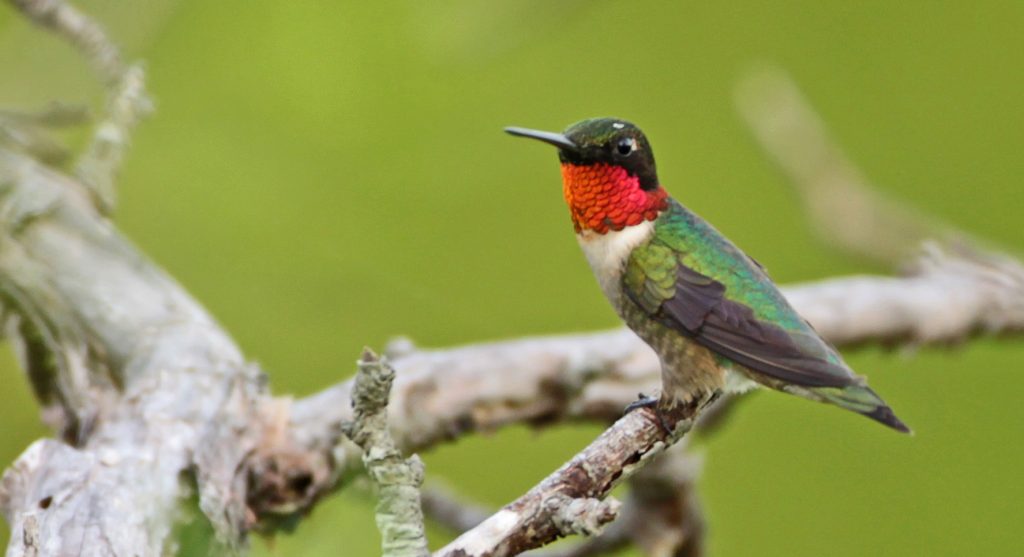
Tiny Bird, Mighty Flyer
The ruby-throated hummingbird is a tiny, fast-flying bird known for its incredible wing speed. It beats its wings more than 50 times per second, producing the distinctive humming sound. In addition to the humming of its wings, it makes soft, mouse-like squeaking calls. Both sexes have shimmering metallic green-gold upperparts and white underparts. Males have a brilliant ruby-red throat and a forked tail, while females have a plain white throat and a square tail with white tips.
One of the Smallest Bird in the World
The Ruby-throated Hummingbird (Archilochus colubris) is one of the smallest birds found in North America, measuring about 7–9 cm long and weighing only around 2–6 g. Males are easily recognised by their brilliant ruby-red throats, while females have a pale, unmarked throat. Despite its tiny body, this hummingbird is remarkably energetic, hovering in place as it feeds on flower nectar and small insects. Its rapid wingbeats and ability to fly forwards, backwards, and even briefly hover make it an impressive aerial performer. Although it is tiny compared with many other birds, it is not the smallest bird in the world. The Bee Hummingbird of Cuba holds the title of smallest bird in the world.
A Seasonal Journey
The ruby-throated hummingbird breeds across the eastern United States and southern Canada. It inhabits forests, woodland edges, meadows, orchards, gardens, and other flower-rich habitats. During autumn, it migrates to Mexico and Central America for the winter. It returns to its breeding range in spring, with males arriving earlier than females.
Fuel for Flight
The ruby-throated hummingbird feeds mainly on flower nectar, especially from red or orange tubular flowers, using its long, slender bill. It also eats small insects for protein and occasionally drinks tree sap. These birds readily visit hummingbird feeders filled with sugar water. They are highly territorial and often defend their feeding areas from other hummingbirds and other animals.
Family Life Among the Branches
The ruby-throated hummingbird is the only hummingbird species that regularly breeds in the eastern United States. It is solitary except during the breeding season. Males perform impressive aerial courtship displays to attract females. However, only the female builds the nest, incubates the eggs, and cares for the young.
A Tiny Nest, A New Generation
She constructs a tiny, well-camouflaged cup-shaped nest from plant fibers, grasses, spider silk, and lichens. She usually places it on a tree branch. The female lays 2–3 white eggs, which hatch after about 12–14 days. The chicks fledge approximately 20–22 days after hatching. The female may raise one to three broods each year.
Challenges in the Wild
The ruby-throated hummingbird is common, widespread, and not currently considered threatened. However, it faces several challenges. These include habitat loss caused by development and agriculture, collisions with windows, and predation by free-roaming domestic cats.