Life on the Savannah
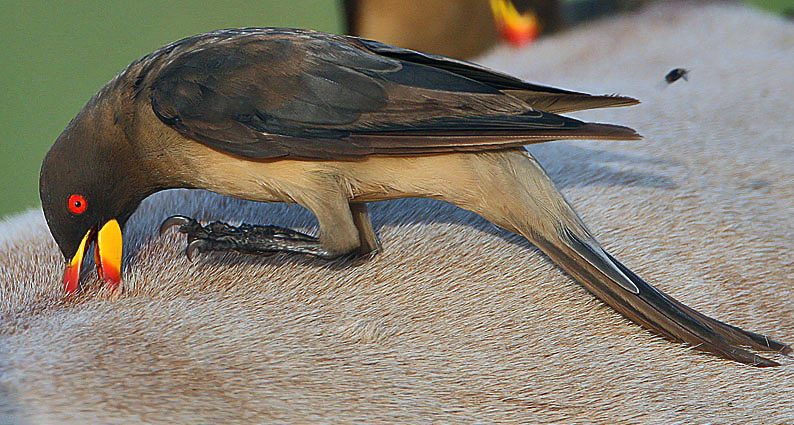
The Yellow-billed Oxpecker is a distinctive bird of the African savannah, easily recognised by its striking yellow-and-red bill and its close association with large mammals. Measuring about 20 cm in length and weighing between 57 and 71 g, this medium-sized bird has strong legs and sharp claws that allow it to cling securely to the hides of moving animals. Adults display dark brown to olive-grey plumage on the upperparts, with lighter brown underparts and a pale rump. Their bright red eyes, surrounded by yellow eye-rings, add to their unique appearance. Juveniles resemble adults but have brown eyes and an entirely yellow bill. They gradually develop the adult coloration within their first year.
Voices Across the Grasslands
The species lives widely across sub-Saharan Africa. It inhabits open savannahs, grasslands, and lightly wooded areas where large wild herbivores and livestock are abundant. Moreover, its characteristic hissy, crackling call, often described as “krisss, krisss,” is a familiar sound across these landscapes.
Partners of the Giants
The Yellow-billed Oxpecker is best known for its remarkable relationship with large mammals such as buffalo, antelope, giraffes, rhinoceroses, and cattle. Perched on their backs, it feeds primarily on ticks, fleas, and other parasites, helping reduce parasite loads on its hosts. A female Yellow-billed Oxpecker may consume hundreds of ticks in a single day. In addition to parasites, it occasionally feeds on earwax, mucus, and blood from open wounds. However, this behaviour can sometimes delay healing.
Bonds That Last
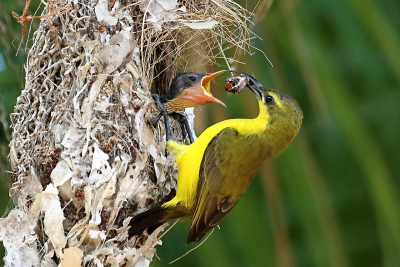
Outside the breeding season, Yellow-billed Oxpeckers are highly social birds that often form large, vocal groups. During the breeding season, which usually coincides with the rainy months, pairs form strong monogamous bonds. Courtship involves mutual preening and soft calls, often while perched on large mammals. They nest in tree cavities or abandoned woodpecker holes lined with hair plucked from mammals. Females usually lay two to three eggs. Both parents incubate the eggs for about 12–14 days. The chicks hatch blind and helpless. They remain dependent on parental care for several weeks after fledging.
Guardians of Balance
Although it is listed as Least Concern, the Yellow-billed Oxpecker faces growing challenges from habitat destruction, declining wildlife populations, and the widespread use of livestock pesticides that reduce its food supply. Nevertheless, as a natural parasite controller and an indicator of healthy savannah ecosystems, this remarkable bird plays a vital role in maintaining ecological balance across the African landscape.