Overview
Arabian Jasmine is an evergreen tropical shrub or twining vine belonging to the olive family (Oleaceae). It is valued for its attractive white flowers, glossy foliage, and sweet fragrance. People believe Jasminum sambac originated in South and Southeast Asia, and growers now cultivate it widely across tropical and subtropical regions worldwide. Its versatility, extended blooming period, and ease of cultivation make it a popular choice for gardens, patios, containers, and trellises.
Other Names of Arabian Jasmine
People know Jasminum sambac by several names across different regions. Common names known widely are Arabian Jasmine, Sambac Jasmine, and Mogra.
| Country /Region | Name(s) |
|---|---|
| India | Motia, Mallige, Mallika, Mallepuvvu, Arabian Mulla, and Bela |
| Philippines | Sampaguita |
| Indonesia | Melati Putih |
| Thailand | Mali La or Mali Son |
| Hawaii | Pīkake |
Description
Arabian Jasmine typically grows 6–10 feet (1.8–3 m) tall and spreads 6–10 feet (1.8–3 m) wide, while regular pruning and training help gardeners control its size. The plant has slender green to light-brown stems that gradually become woody with age and may climb when provided with support.
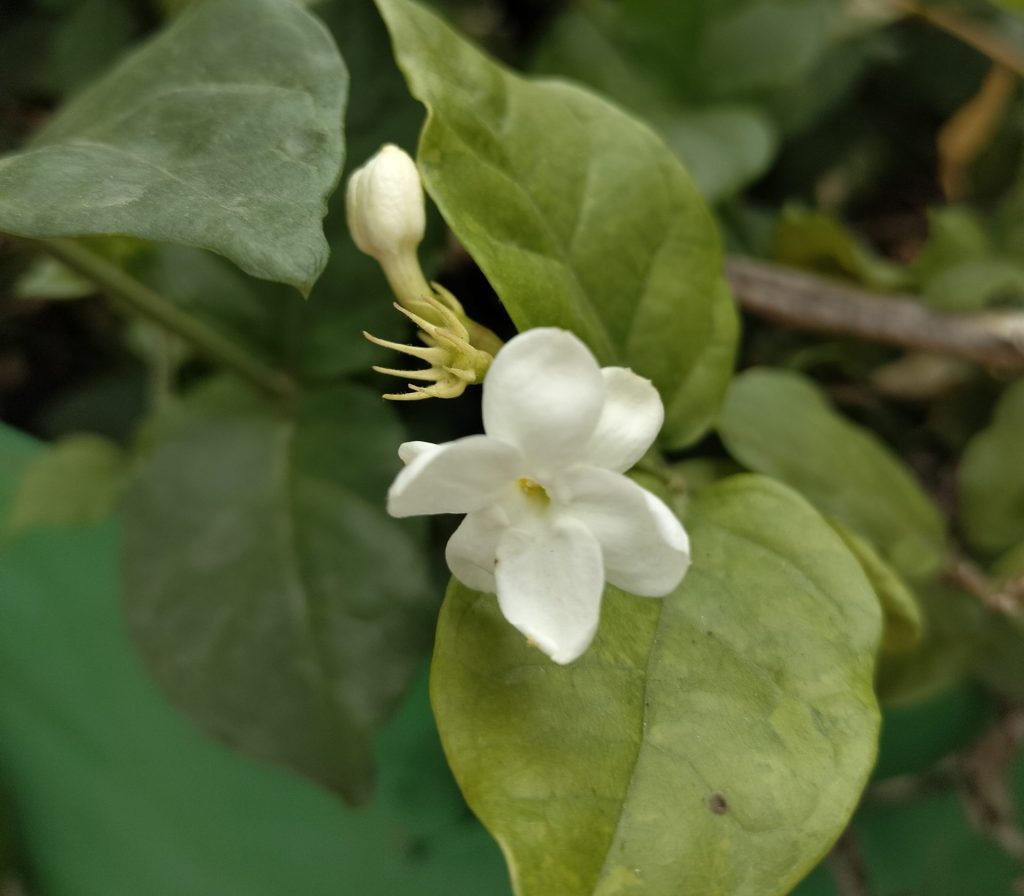
The leaves are simple, glossy, and dark green, usually arranged in opposite pairs or occasionally in whorls of three along the stems. Each leaf is oval to broadly ovate in shape with a smooth margin, creating dense, attractive foliage.
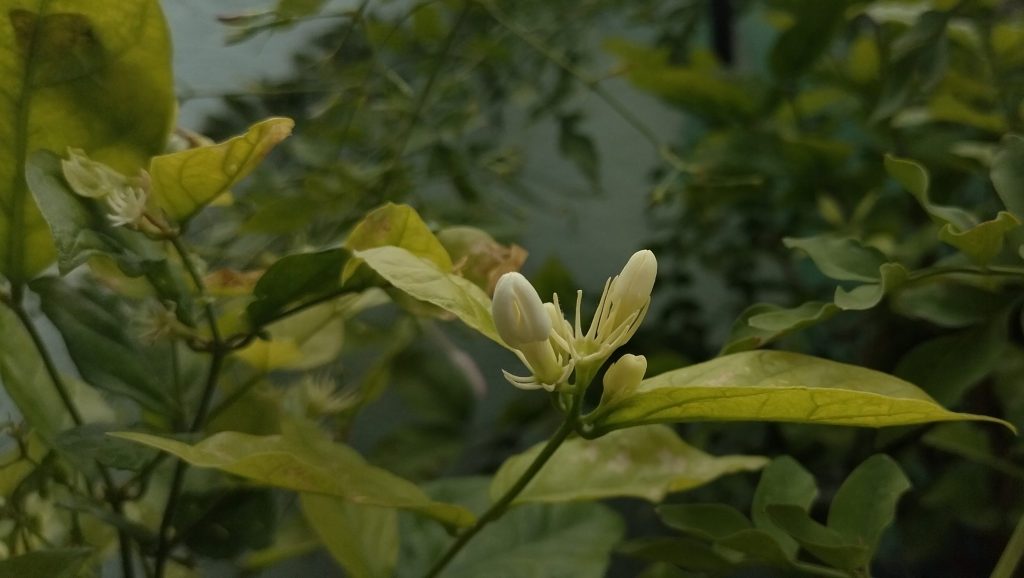
Arabian Jasmine produces clusters of small, waxy flowers at the ends of branches. The blooms are typically pure white, though they may develop a soft pink tint as they age. Depending on the cultivar, flowers can have single, semi-double, or double petals. Individual flowers often open in the evening and release their strongest fragrance during the night and early morning. Flowering occurs mainly during summer but may continue sporadically throughout the year.
Arabian Jasmine Care and Growth
Arabian jasmine thrives in full sun to partial shade and grows best in fertile, well-drained soil. Water regularly during the growing season to keep the soil evenly moist, but avoid waterlogging. Reduce watering during cooler months when growth slows, and apply a balanced fertiliser monthly during the active growing season to support healthy growth and flowering.
When grown as a vine, provide support such as a trellis, fence, or arbour and gently guide young stems as they develop. Since the plant does not naturally cling to surfaces, occasional tying may be necessary.
Prune lightly after flowering to maintain the desired size and shape. Remove dead, damaged, or overcrowded stems to improve air circulation and encourage new growth. Container-grown plants may require occasional trimming to keep them neat and compact.
Propagation of Arabian Jasmine
Gardeners commonly propagate Arabian Jasmine through stem cuttings and layering, preferably during the warm growing season.
For stem cuttings, gardeners select healthy, partially mature stems and take semi-ripe cuttings. They remove the lower leaves and place the cuttings in a moist, well-drained propagation medium. Bright, indirect light helps the cuttings develop roots. Once the roots establish, gardeners can transplant the young plants to their permanent location.
Layering provides another simple propagation method. Gardeners bend a flexible stem toward the ground and cover part of it with moist soil while keeping it attached to the parent plant. The covered section develops roots over time, after which gardeners can separate the new plant and transplant it. This method often produces strong, well-established plants.
Types of Arabian Jasmine
Gardeners commonly grow several cultivars of Arabian Jasmine, each with distinct flower forms. Some famous ones are:
- ‘Grand Duke of Tuscany’ produces double or semi-double flowers with a rose-like appearance.
- ‘Belle of India’ produces single or double flowers with longer petals.
- ‘Maid of Orleans’ produces rounded, single petals and may propagate more easily than some other cultivars.
Pests and Diseases
Aphids, mealybugs, scale insects, and spider mites may occasionally attack Arabian Jasmine, particularly when gardeners grow the plant indoors or in containers. These pests feed on plant sap and can weaken growth if left unmanaged.
Root rot caused by excessive moisture or poor drainage is the most common disease issue. Environmental stresses such as drought, cold temperatures, or sudden changes in growing conditions may lead to bud drop, while inadequate sunlight, excessive fertilisation, or root stress can reduce flowering. Proper watering, good drainage, and adequate air circulation help prevent most problems.
Wildlife and Ecological Value
The nectar-rich flowers attract pollinators such as bees and butterflies, helping support biodiversity in gardens and landscaped areas. As a long-blooming ornamental plant, it provides a valuable nectar source for beneficial insects throughout much of the growing season.
Uses and Cultural Significance
People widely use Arabian jasmine in perfumes, essential oils, and jasmine tea. They also weave its flowers into garlands, leis, and decorative arrangements for religious ceremonies, festivals, weddings, and other special occasions. The plant symbolises purity, love, beauty, and devotion in many cultures.

Krishna Janmashtami, India
It is believed that the divine fragrance of Arabian Jasmine attracts Lord Krishna himself. The flowers’ presence in the temples is said to invoke a calm ambience. Garlands of this flower are used to decorate the idol and altar of Lord Krishna during Janmashtami celebrations.
National Flower
The Philippines recognises Arabian jasmine as its national flower, while Indonesia recognises it as one of its national flowers, reflecting its deep cultural significance across Asia.
Frequently Asked Questions
Arabian Jasmine has gained popularity because of its fragrant white flowers, glossy evergreen foliage, long flowering period, and cultural importance. People grow it as an ornamental plant and use its flowers in perfumes, teas, garlands, religious ceremonies, weddings, and festivals.
Yes. Arabian Jasmine grows well in containers when you provide sufficient sunlight, fertile and well-drained soil, regular watering, and occasional pruning. Container-grown plants may need regular trimming to maintain a compact shape.