
Built for Speed
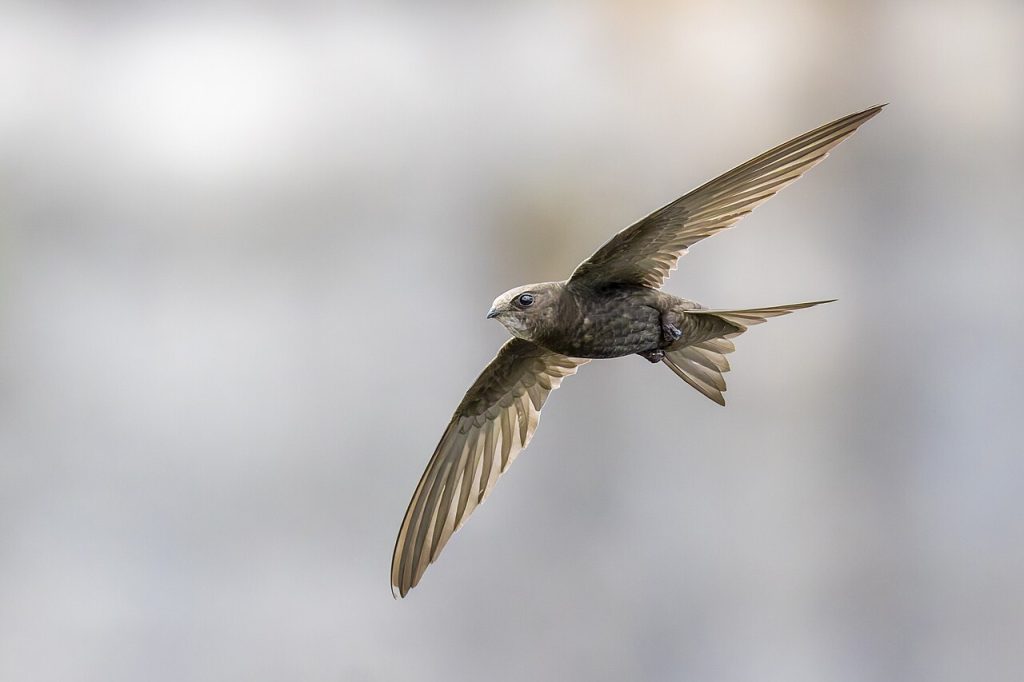
The Common Swift is a slender, fast-flying bird with a distinctive, streamlined body. It has long, scythe-shaped wings, a short, forked tail, dark brown plumage, and a pale throat patch. The adults are usually sixteen to seventeen centimeters long, but their magnificent wingspan gives them extraordinary aerial performance. Their tiny legs are equipped with powerful, curved claws, and they can cling tightly to vertical surfaces, but they are not well adapted for walking.
A Life in the Air
This species is predominantly aerial, spending most of its time on the wing feeding, drinking, sleeping, and even mating in flight. A fascinating fact about Common Swifts is that they are capable of remaining airborne for months at a stretch outside the breeding season. Their rapid flight and incredible stamina are among the greatest feats of avian evolution.
Hunting on the Wing
The common swift’s diet is almost entirely made up of flying insects and aerial spiders, which they catch with their wide mouths in the air at high speed. This feeding behavior naturally decreases insect populations and helps to maintain the ecological balance in a variety of terrains. Common Swifts are among the most efficient aerial insectivores in terms of wing loading, which supports energy-efficient, continuous flight with little energy expenditure.
Epic Migrations and Family Life
It breeds across Europe and parts of western Asia, migrating thousands of kilometers to sub-Saharan Africa for the non-breeding season. Common Swifts use cities, towns, villages, cliffs, woodlands, and open country, if nesting cavities are available. They court with spectacular high-speed pursuits, punctuated by their loud, screaming calls that echo across the summer sky. Pairs usually nest in crevices of buildings, roof spaces, cliffs, or specially built nest boxes lined with feathers and light plant material gathered in flight. The female generally lays two or three white eggs, while both parents share incubation and chick care. The young remain in the nest for several weeks until the time comes for their first, memorable flight.
Facing Modern Challenges
Predators are peregrine falcons, hobbies, large gulls, and climbing mammals that sometimes visit nesting sites. Their high speed, high maneuverability, and ability to fly at high altitude greatly reduce the risks of predation. Habitat loss, decline of insects, renovations of modern buildings that take away nesting spaces, and environmental changes related to climate are among the increasing conservation challenges. Conservation measures include encouraging the protection of traditional nesting sites and providing artificial nest boxes in urban areas.
From Nature to Peppa Pig
The Common Swift is one of the birds that makes an appearance in the popular kids’ show, Peppa Pig. The touching “Little Swift” episode introduces children to this amazing migratory bird while teaching kindness toward wildlife.
Common Swift: A Master of Flight
The common swift is without doubt one of the most marvelous birds in the world. Its constant aerial lifestyle, its amazing migrations, and its incredible flight adaptations all testify to the wonders of avian evolution.
FAQ
Globally, this is classified as "Least Concern" by IUCN Red List.
Yes. Common Swifts are long-distance migrants. They breed across much of Europe and parts of western Asia before migrating thousands of kilometres south to sub-Saharan Africa during the non-breeding season.
Common Swifts can remain airborne for months at a time outside the breeding season. Research has shown that some individuals can spend roughly 10 months continuously in flight, landing mainly during the breeding season to nest and raise their young.
Common Swifts usually nest in crevices and cavities in buildings, including roof spaces and under eaves. They also nest in cliffs and other suitable structures. Artificial nest boxes can provide additional nesting sites where natural cavities are limited.
Common Swifts feed mainly on flying insects and aerial spiders, which they catch while flying. They spend much of their time feeding high in the air rather than searching for food on the ground.
Common Swifts have very short legs and feet adapted mainly for clinging to vertical surfaces. They are poorly adapted for walking on the ground, which is one reason they spend so much of their lives in the air.