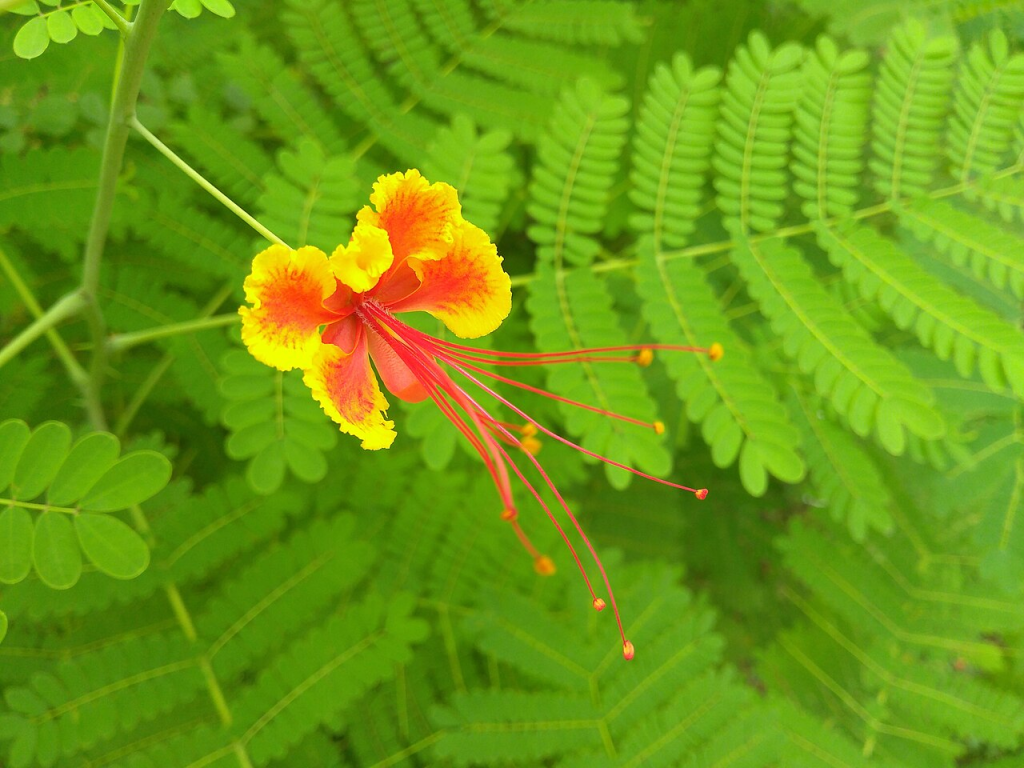
What Makes Peacock Flower So Colorful?
Peacock Flower (Caesalpinia pulcherrima) is a tropical shrub or small tree of the legume family, Fabaceae. It is usually about three meters tall, with branched stems and finely divided leaves composed of many small leaflets. Some plants have scattered prickles on their branches, a useful identifying feature.
Primarily, the flowers appear in loose clusters with long, prominent stamens protruding past the petals. Individual flowers may have combinations of scarlet, red, orange, and yellow, and the color patterns may vary from plant to plant. In warm climates, flowering may occur for much of the year, particularly where conditions are favorable for growth. After pollination, the plant produces flat, elongated pods with several seeds inside.
Names Around the World
Peacock Flower has numerous common names across its native and introduced range. Some widely used English names include Peacock Flower, Pride of Barbados, Barbados Pride, Dwarf Poinciana, Red Bird of Paradise, and Flower Fence.
Peacock Flower also has an important cultural connection with Barbados. Barbados chose the Peacock Flower as its national flower, and it appears on the upper corners of Queen Elizabeth II’s personal Barbadian flag.
In India, regional names include Mayil Konrai and Mayir-Konrai in Tamil, Rajamalli and Settimandaram in Malayalam, Ratnagandhi in Telugu and Kannada, and Sankasur in Marathi.
Several Southeast Asian countries have their own local names for the plant. Bunga merak or kembang merak is the name for peacock flower in Indonesia, while local communities in the Philippines, Cambodia, Thailand, and Vietnam use other names.
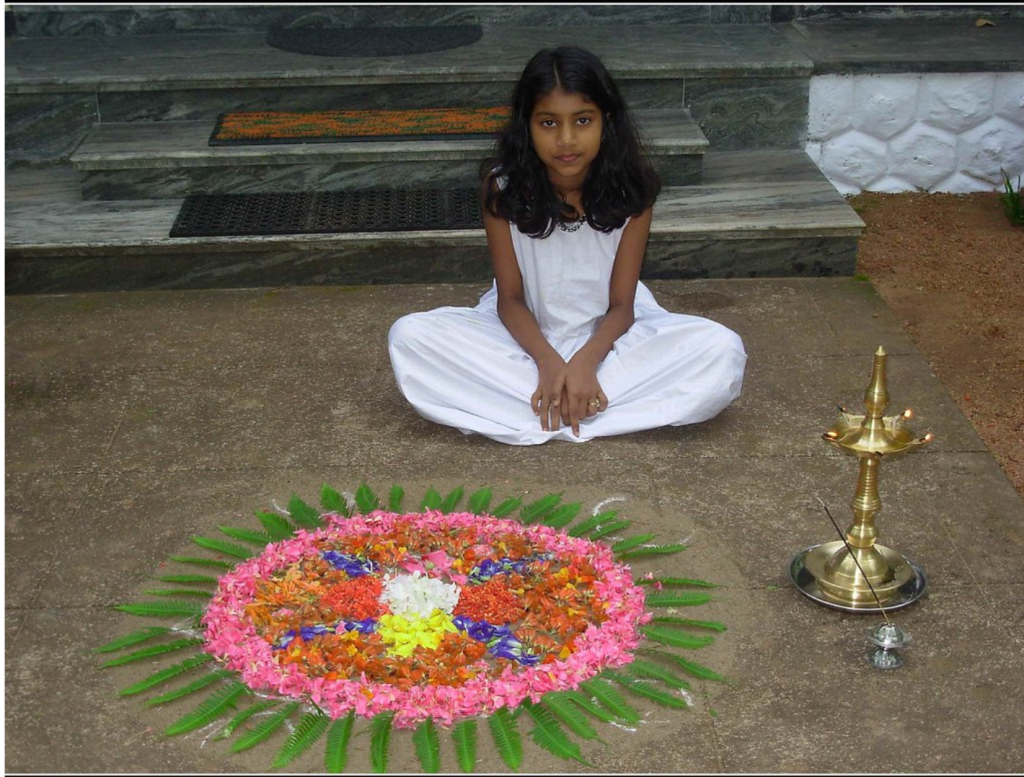
Peacock Flower in Onam Pookkalam Designs
In Kerala, these warm tones can complement the vibrant patterns of Onam Pookkalam, especially when gardeners use locally available flowers in seasonal designs. The open flower clusters and contrasting colors can provide a visual change with smaller flowers for detailed arrangements. Thus, its decorative value is primarily from the bold colors and form of its blooms rather than from a fixed role in traditional Pookalam customs.
Where Peacock Flower Grows Naturally
The peacock flower is native to southeastern Mexico and Central America, occurring primarily in seasonally dry tropical environments. It grows widely as an ornamental shrub in India and other tropical and subtropical regions.
The plant grows well in full sun, which encourages vigorous growth and flowering. Well-drained soil helps prevent problems caused by excessive moisture. Its hard-coated seeds can germinate slowly, but suitable seed treatments can improve and speed up germination.
Once established, the peacock flower can tolerate relatively dry conditions better than many moisture-loving ornamental plants. Its finely divided foliage gives the shrub a light, airy appearance despite its dense branching habit. Regular pruning can help maintain a compact shape.
Its Role in Gardens and Floral Designs
Its branching habit makes it useful for gardens, borders, hedges, and open landscapes, while regular pruning can help maintain a compact form. The flowers can also contribute to wildlife-friendly gardens by providing nectar and pollen for visiting insects, including bees and butterflies. The plant’s seeds may provide food for some seed-eating organisms. For floral decorations, its unusual flower structure and intense colors make it useful as an accent flower. Rather than blending into an arrangement, the blooms can provide a strong visual focal point.
Medicinal and Historical Uses
Traditional medicine has used different parts of the plant, involving the leaves, flowers, bark, roots, and seeds, to treat various ailments.
Historical sources also describe more concerning uses of the plant. People have historically used preparations from its seeds and other parts to induce abortion. Some accounts also report its use in suicide attempts because certain parts of the plant can be toxic. These historical uses are not recommendations for medicinal use. The plant contains biologically active compounds, and consuming its seeds or other parts can be dangerous. Current evidence does not establish the safety, appropriate dosage, or effectiveness of these preparations for self-medication.
Research has investigated various compounds in C. pulcherrima for biological activities, including antimicrobial, antioxidant, anti-inflammatory, and other effects. However, laboratory or traditional evidence does not by itself establish a treatment as safe or effective in humans.
Frequently Asked Questions
The name refers to its showy, colourful flowers, which have prominent stamens extending beyond the petals.
Yes. Different parts of Peacock Flower have been used traditionally for various ailments. However, some parts can be toxic, and traditional medicinal uses should not be considered proven or safe treatments.