
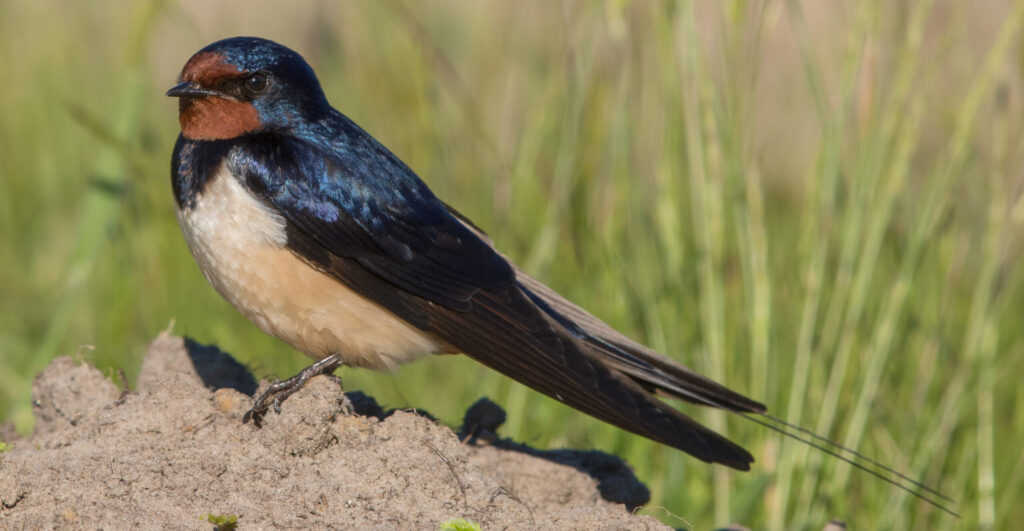
The Barn Swallow is a slim and very distinctive bird with shiny blue upperparts, a reddish throat, pale underparts and a deeply forked tail. An aerodynamic body and long, pointed wings make it one of the most skilled of all passerine flyers. Adults have long streamers on their tails that improve their looks and their flying skills. Dark eyes and a short, wide bill are adaptations to its insectivorous lifestyle, catching insects on the wing.
Life in the Fast Lane
This is a bird that spends much of its life in flight and is incredibly agile when chasing prey in the air. It is able to hunt efficiently over open country with quick turns , steep dives and sudden changes in direction . The Barn Swallow feeds mainly on flying insects such as flies , beetles , mosquitoes , winged ants and other small air-borne invertebrates . It frequently feeds over fields, wetlands, rivers, grasslands, and agricultural areas where insects are still plentiful and at different heights depending on weather and prey availability.
Journeys Across Continents
The species is renowned for its long seasonal migrations. Northern-breeding populations migrate thousands of kilometers to warmer wintering grounds. These migrations are among the most extraordinary of small birds. Barn Swallows are most abundant in rural landscapes, villages, farms, wetlands and cities. Their close association with human structures has been a major factor in their global success.
Mud, Feathers, and Family
Breeding pairs construct cup-shaped nests of pellets of mud reinforced with grass and lined with soft feathers. Nests are generally fixed to the undersides of roofs, bridges, barns and protected ledges. Females lay multiple eggs and both parents take turns in incubation and caring for the chicks. The young are fed continuously with insects and develop good flying skills quickly.
Challenges in the Open Sky
Natural predators include hawks, falcons, snakes and mammals able to reach nests. Rapid flight, colony nesting and strategic nest placement help to reduce predation.
This species has the ability to remain airborne for long periods of time and an impressive navigational accuracy in migration. Scientists have observed that some individuals return to the same breeding sites year after year.
Its endurance, versatility and mastery of flight of the Barn Swallow has made it one of the most common birds on the planet. For many parts of the world, it is an iconic image of seasonal change, the Barn Swallow gliding gracefully through open skies. Endurance and flexibility are part of the secret of its global success.