A Familiar Face of Spring
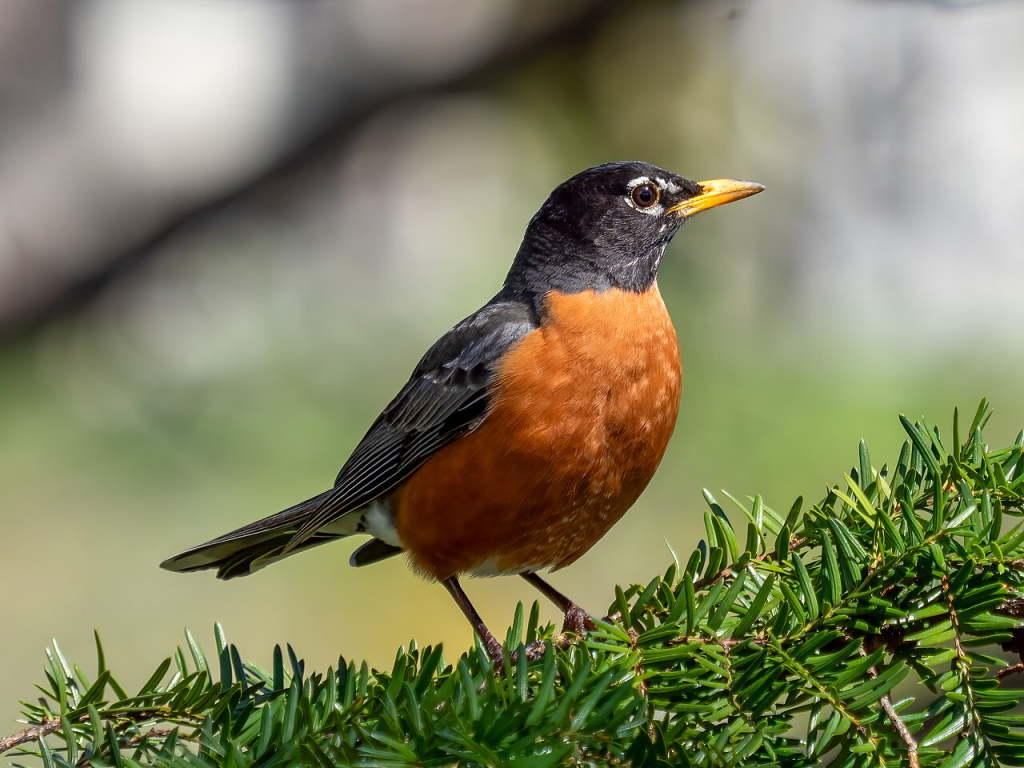
The American Robin is a medium-sized songbird. It has a warm orange-red breast, a grayish-brown back, a dark head, a bright yellow bill, and a conspicuous white eye ring. The adult is usually 23 – 28 cm long, with long legs adapted for efficient foraging on the ground. Its rounded body, broad wings, and moderately long tail allow rapid direct flight between feeding and nesting areas. Males tend to be darker than females; however, both sexes have similar markings. The American Robin is one of the first birds to announce the arrival of spring. Additionally, its melodious song often fills the air at dawn and dusk.
Feeding Through the Seasons
Their diet changes with the seasons and includes earthworms, insects, beetles, caterpillars, spiders, berries, and a variety of wild fruits. This varied diet helps control insect populations while dispersing seeds across forests, fields, and other natural habitats.
American Robins inhabit deciduous forests, woodland edges, parks, suburban gardens, orchards, grasslands, and urban neighborhoods throughout much of North America. Birds living in milder regions often remain in the same area year-round. However, robins that breed in northern regions migrate south as temperatures fall and food becomes less available.
From Courtship to Parenthood
Before breeding pairs establish territories, there are singing, chase flights, and visual displays in courtship. Female American Robins build neat cup-shaped nests from grasses, twigs, mud, and fine plant materials. They usually place their nests in tree branches, shrubs, buildings, or sheltered ledges. Clutches normally contain three to five characteristic blue eggs. The female incubates the eggs for most of the nesting period. Both parents feed and protect the chicks until they fledge. American Robins can raise more than one brood in a breeding season. They do so when environmental conditions remain favorable.
Surviving in a Changing World
Hawks, owls, snakes, squirrels, domestic cats, raccoons, and crows prey on American Robin eggs, nestlings, and adults. American Robins reduce the risk of predation by staying alert, giving alarm calls, and flying away quickly. Although the species remains widespread and abundant, habitat modification, pesticide exposure, window collisions, and free-ranging domestic cats continue to threaten local populations. Conservation efforts focus on protecting green spaces, reducing pesticide use, and preserving nesting habitats. With its cheerful song, seasonal movements, ecological importance, and adaptability, the American Robin remains one of North America’s most familiar and beloved birds.