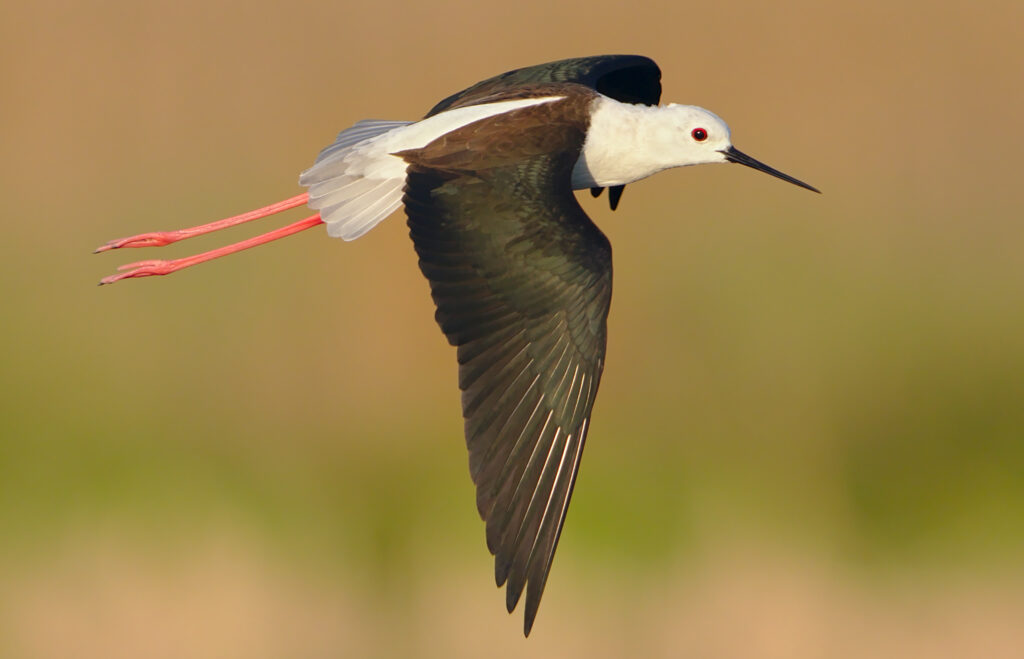
The Black-winged Stilt is a striking wetland bird, easily recognizable as a wading bird, admired for its exceptionally long pink legs, slender black bill, and striking black-and-white plumage. Found across Europe, Asia, Africa, and parts of the Americas, this species thrives in a wide variety of wetland habitats, including freshwater marshes, shallow lakes, ponds, flooded fields, estuaries, coastal lagoons, mudflats, and salt marshes.
Black and white beauty
Adult Black-winged Stilts display a glossy black back and wings that contrast sharply with their white underparts, head, and neck. Males typically have a greenish-black sheen on their backs, while females show a slightly browner tone. Juveniles are duller in appearance, with greyish plumage and sandy-colored wing feathers. Their long legs allow them to wade through shallow water with ease, searching for food.
The Black-winged Stilt feeds primarily on insects, crustaceans, worms, mollusks, spiders, and other small aquatic creatures. It forages by slowly walking through shallow water and picking prey from the surface, mud, or sand. Depending on food availability, the species may employ different feeding techniques to maximize its success.
Distinctive features and adaptibility
These birds are highly social and often gather in small groups or large flocks, particularly during migration and roosting. Their distinctive calls, a rapid and nasal “”kek-kek-kek,”” are frequently heard in wetland areas. Although mainly active during the day, they are also capable of foraging at night, even under very low light conditions. Its adaptability to different environments has contributed to its widespread distribution and stable population.
During the breeding season, pairs establish territories in wetland habitats and construct simple nests on the ground, often on small islands or exposed mud patches. The species is seasonally monogamous, with pairs forming strong bonds during the breeding season. Nests are simple scrapes on the ground, often located on small islands or open patches of mud and vegetation.
Beauty and beasts
Females usually lay up to four eggs per clutch. Eggs are light-colored with dark spots helping them blend into their surroundings. Both parents share the responsibility of incubating the eggs, which usually hatch after about 22 to 26 days. Chicks hatch well-developed and leave the nest within a day, becoming capable of flight after about a month.
Black-winged Stilts are preyed upon by hawks, eagles, foxes, feral dogs, and snakes. Their eggs and chicks are especially vulnerable due to their exposed ground nests and may also be taken by crows, gulls, and other opportunistic predators.
The Black-winged Stilt exhibits diverse migration patterns, with some populations undertaking long-distance journeys while others remain resident year-round. Although currently classified as Least Concern by the IUCN and showing an increasing population trend, the species remains vulnerable to habitat degradation, wetland loss, and other human-induced environmental changes.