Across Continents and Wetlands
The Greater Flamingo is the largest and most widely distributed flamingo species. It inhabits shallow saline and alkaline wetlands such as salt lakes, coastal lagoons, mudflats, and saltworks across Africa, western Asia, and southern Europe. While it can travel long distances outside the breeding season, it shows strong site fidelity, repeatedly returning to traditional breeding sites. Migration behavior differs among populations, with some remaining resident and others making seasonal movements.
The Large Pink Bird
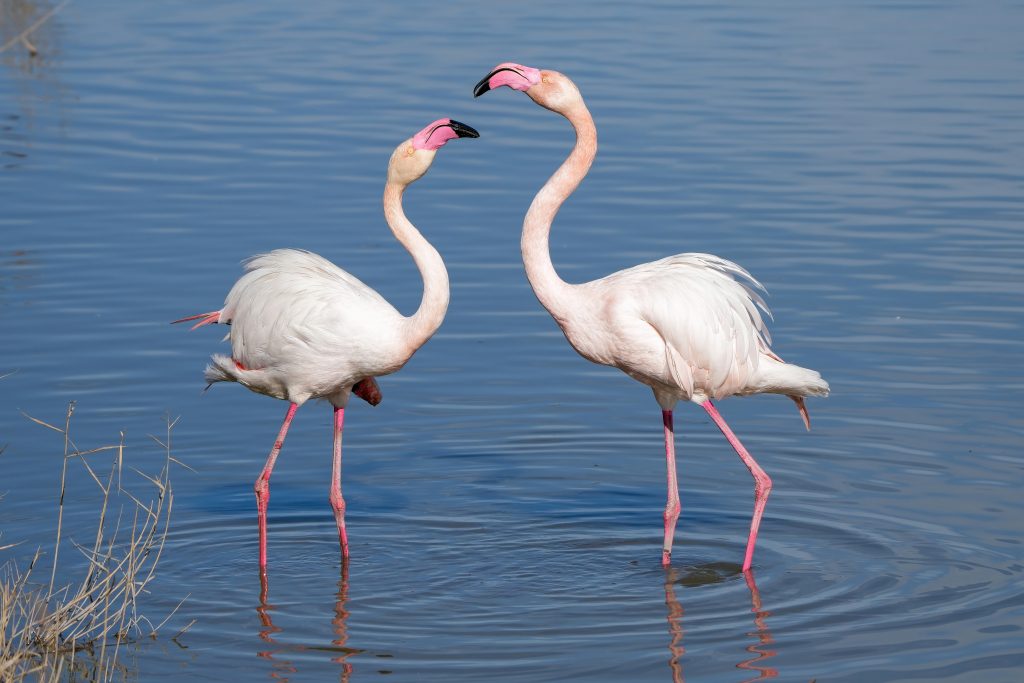
The species has an elegant form and distinctive coloration. Adult Greater Flamingos show pinkish-white plumage with bright red wing coverts, black flight feathers, yellow eyes, and long pink legs. They have a downward-curved pink bill with a black tip that helps in feeding. Adults reach heights of 110–150 cm, making them the tallest flamingo species, with males generally larger than females. Juveniles look different, with greyish-brown plumage, minimal pink tones, and mainly brown bills and legs.
Filter Feeding Adaptations
Synchronized Courtship Displays
Breeding takes place in large colonies that can include thousands of pairs. In addition, the species is seasonally monogamous, with pair bonds lasting for a single breeding season. Courtship includes synchronized displays such as head-flagging, wing-raising, and marching. Pairs construct cone-shaped mud nests in shallow wetlands, where the female lays a single chalky-white egg. Both parents incubate the egg for about 27–31 days.
Path to Flight
Safeguarding Wetland Habitats
The Greater Flamingo is a long-lived species, with a lifespan of 30–40 years in the wild and over 60 years in captivity. Despite its adaptability, it is threatened by habitat loss and degradation, hunting, trapping, pollution, and human disturbance. Because breeding colonies are highly sensitive to disturbance, conservation efforts focused on protecting wetlands and minimizing disturbance are essential for ensuring the long-term survival of this iconic waterbird.