Meet the Mallard
The Mallard is one of the world’s most familiar ducks and, for many people, the first wild duck they ever learn to recognise. Whether gliding across a quiet village pond, dabbling in a marsh, or paddling through an urban park, this adaptable bird feels equally at home in natural wetlands and human-made habitats.
Found across much of the Northern Hemisphere and introduced to several other parts of the world, the Mallard has become one of the most widespread and successful waterfowl species. Its striking appearance, fascinating behaviour, and remarkable adaptability have also made it the ancestor of nearly all domestic duck breeds.
A Colourful Character
Mallards are medium to large dabbling ducks, measuring 50–65 cm (20–26 inches) in length with a wingspan of 79–97 cm (31–38 inches). Adults typically weigh between 900 g and 1.6 kg (2–3.5 lb).
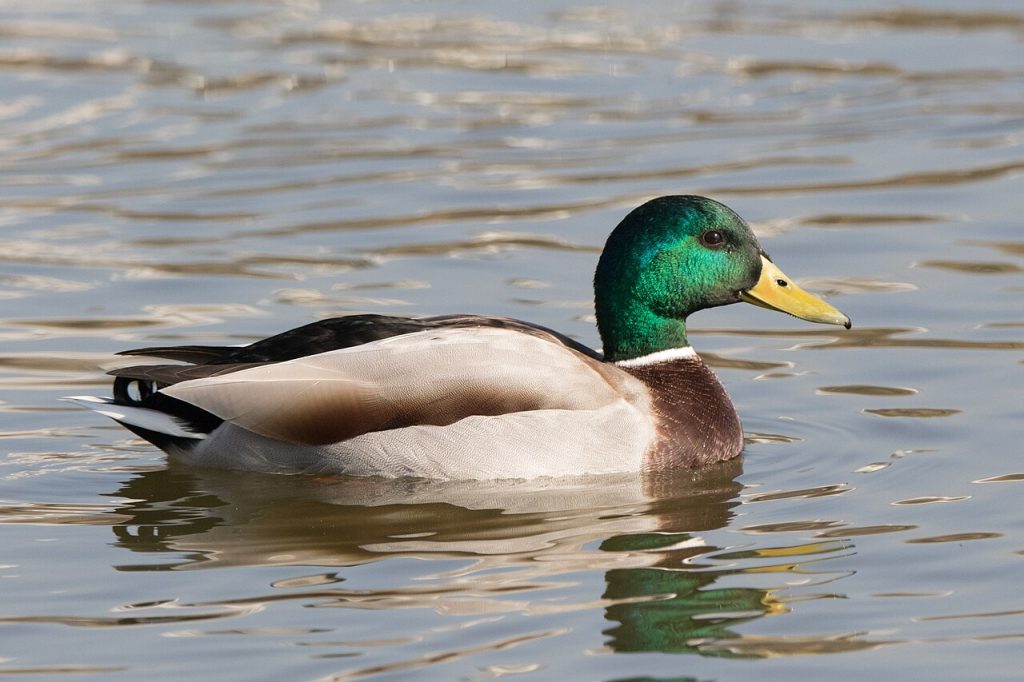
The drake, or adult male, is unmistakable. His iridescent green head, bright yellow bill, narrow white neck ring, and rich chestnut breast stand out against a pale grey body. Females are much more subtly coloured, with beautifully mottled brown plumage and an orange bill marked with black. Their understated colouring provides excellent camouflage while nesting.
Both sexes share one distinctive feature—a shimmering blue wing patch, known as the speculum, bordered by crisp white edges that become especially noticeable in flight.
At Home Wherever There’s Water
One of the Mallard’s greatest strengths is its ability to adapt. It thrives in an impressive variety of habitats, from marshes, lakes, rivers, and estuaries to farm ponds, roadside ditches, and city parks. Some have even been known to visit garden ponds and backyard swimming pools.
Native to temperate and subtropical regions of North America, Europe, Asia, and North Africa, Mallards have also been introduced to countries including Australia, New Zealand, South Africa, and parts of South America.
Many northern populations migrate seasonally to avoid freezing conditions, travelling in mixed flocks to milder areas. Elsewhere, particularly in urban environments where food remains plentiful, Mallards often stay in the same area throughout the year.
What’s on the Menu?
Mallards are true opportunists when it comes to food. As dabbling ducks, they feed by tipping forward in shallow water, reaching underwater with their bills while their tails point skywards.
Their varied diet includes aquatic plants, seeds, grains, insects, crustaceans, molluscs, small fish, tadpoles, and other aquatic creatures. They also forage on land, particularly in fields and grassy areas, where they search for seeds and invertebrates.
This flexible diet allows Mallards to thrive in habitats where food availability changes with the seasons.
Life on the Water
Mallards are sociable birds and are often seen in pairs or groups, with much larger flocks gathering outside the breeding season. During migration, they frequently travel in the familiar V-shaped formations that help conserve energy on long journeys, reaching speeds of up to 55 mph (89 km/h).
Their calls are equally recognisable. While the male’s voice is a soft, raspy whistle or quiet, reedy call, the female produces the loud, classic “quack” that most people associate with ducks.
Finding a Mate and Raising a Family
As autumn turns to winter, Mallards begin forming seasonal breeding pairs. Males compete for attention with an entertaining series of courtship displays, dipping their bills into the water, lifting their heads and tails, splashing, whistling, and grunting to impress potential mates.
Once paired, the female chooses a well-hidden nesting site among tall grasses or dense vegetation close to water. She builds a shallow nest lined with grasses and soft down feathers plucked from her own breast.
A typical clutch contains 7–13 creamy white to olive-buff eggs. The female incubates them alone for 23–30 days, while the male usually leaves before the eggs hatch. After hatching, the ducklings leave the nest within a day and quickly begin feeding themselves under their mother’s watchful care. They are capable of flight at around 52–60 days of age.
Staying Safe
Although adult Mallards are strong fliers, they face many predators throughout their lives. Foxes, raccoons, mink, birds of prey, large fish, and snapping turtles may prey on ducklings or eggs, while adult birds must remain alert for predators both on land and in the air.
Ducklings rely on camouflage, quick reflexes, and their mother’s protection during their first few weeks, when they are most vulnerable.
Why Mallards Continue to Thrive
Unlike many wetland birds, the Mallard has adapted remarkably well to changing landscapes. Its flexible diet, ability to use a wide range of habitats, and willingness to live alongside people have helped it remain one of the world’s most abundant ducks.
Even so, healthy wetlands remain essential for breeding and migration. Conserving ponds, marshes, rivers, and other freshwater habitats benefits Mallards as well as countless other birds, mammals, amphibians, and insects that depend on these ecosystems.
Scene Stealer
Did you know? Mrs. Duck and her ducklings, in Peppa Pig, are some of the show’s most beloved animal characters. They are based on the Mallard. Their lovely interactions with Peppa and “quack-quack” calls are endearing to watch, introducing young viewers to the charming world of ducks.
A Duck That Feels at Home Almost Anywhere
From peaceful woodland lakes to bustling city parks, the Mallard has shown an extraordinary ability to adapt to life alongside people. Its colourful plumage, familiar calls, and relaxed nature have made it one of the world’s best-loved waterbirds.
Whether you’re watching a pair raise ducklings on a village pond or seeing a flock arrive during migration, the Mallard is a reminder that some of nature’s most remarkable birds are often hiding in plain sight.