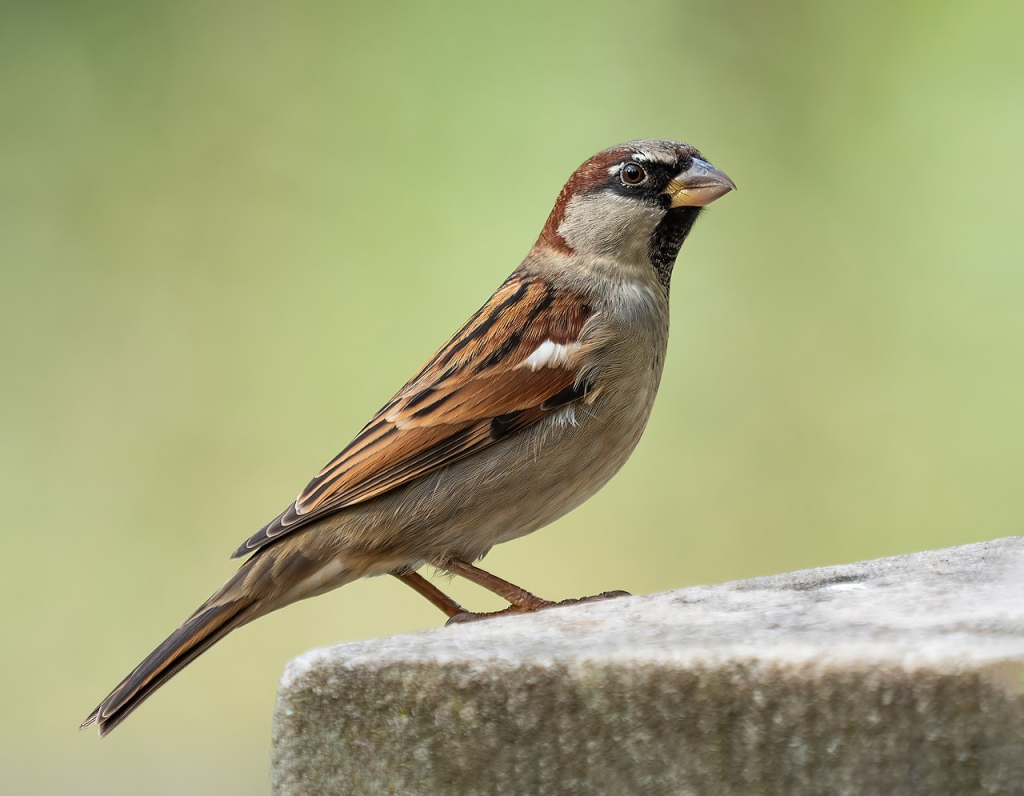
Meet the House Sparrow
Few birds are as familiar as the House Sparrow. Whether it’s hopping beneath a garden feeder, chirping from a rooftop, or darting through a busy high street, this little bird has shared our towns and villages for centuries. Its close relationship with people has helped it spread across much of the world, making it one of the most recognisable bird species on the planet.
Although often overlooked because it is so common, the House Sparrow is a fascinating bird with a remarkable ability to adapt. From bustling cities to quiet farms, it has learned to make the most of almost any place where people live.
Small Bird, Big Personality
The House Sparrow is a small, stocky songbird measuring around 14–16 cm (5.5–6.3 inches) in length. It has a short, conical bill, rounded wings, and a relatively short tail, giving it a sturdy appearance despite its small size.
Adult males are easy to identify by their grey crown, black bib, chestnut-brown nape, and boldly streaked brown back. Females and young birds are much subtler in colour, with soft brown plumage and gentle streaking that helps them blend into their surroundings.
Their strong legs make them excellent hoppers, and their thick bill is perfectly adapted for cracking seeds. Despite their modest appearance, House Sparrows are energetic birds that rarely stay still for long.
Always Close to Home
If there’s one bird that truly enjoys living alongside people, it’s the House Sparrow. Originally native to Europe, Asia, and North Africa, it has followed human settlements around the globe and is now found on every continent except Antarctica.
House Sparrows are common in cities, towns, villages, farms, parks, gardens, and suburban neighbourhoods. They readily nest in buildings, roof spaces, and other sheltered corners, making the most of the opportunities that human environments provide.
Unlike many bird species, most House Sparrows remain in the same area throughout the year. Rather than migrating long distances, they usually stay close to the places where they were raised.
What’s on the Menu?
House Sparrows aren’t fussy eaters. Seeds and grains form the foundation of their diet, but they’re happy to take advantage of whatever food is available. They also feed on insects, spiders, fruits, food scraps, and other small invertebrates.
During the breeding season, insects become especially important. Adult sparrows gather caterpillars, beetles, and other protein-rich prey to feed their growing chicks, giving them the nutrition they need to develop quickly.
By feeding on insects, House Sparrows also provide a natural helping hand in gardens and farmland, where they contribute to keeping insect populations in check.
Life in a Noisy Neighbourhood
House Sparrows are rarely solitary birds. They live in flocks, feed together, and often gather in large, noisy groups before settling down to roost in the evening.
Their constant chorus of cheerful chirps serves several purposes. It helps flock members stay in touch, warns of danger, and strengthens pair bonds during the breeding season. While their calls may sound simple to us, research suggests these birds can recognise individual members of their flock, revealing a surprisingly complex social life.
Watching a flock of House Sparrows in a garden is often a lively spectacle, with birds chasing one another, squabbling over food, and constantly chatting as they go about their day.
Finding a Mate and Raising a Family
Spring brings plenty of excitement for House Sparrows. Males compete for the best nesting sites and try to impress females with persistent chirping, wing displays, and confident posturing.
Once a pair has formed, they build a nest in a sheltered cavity, such as a hole in a building, beneath roof tiles or inside a tree hollow. The nest is made from grasses, feathers, paper, and other soft materials, creating a cosy place for raising young.
A female usually lays three to seven pale eggs speckled with brown. Both parents share the responsibility of incubating the eggs and feeding the chicks after they hatch. Their teamwork gives the young birds the best chance of surviving until they leave the nest.
Staying One Step Ahead
Life isn’t without its dangers for a House Sparrow. Hawks, owls, snakes, crows, squirrels, and domestic cats all prey on eggs, nestlings, or adult birds.
Fortunately, House Sparrows have several ways of protecting themselves. They are alert, agile fliers that quickly dive for cover when threatened, and living in flocks means there are always extra eyes watching for danger. If one bird spots a predator, the entire group reacts almost instantly.
Why Are They Disappearing?
Although the House Sparrow remains one of the world’s most widespread birds, its numbers have fallen in several cities over recent decades.
Modern buildings often provide fewer nesting spaces than older ones, while the loss of green spaces and declining insect populations have reduced the food available for young birds. Increased urban development has also changed many of the habitats that House Sparrows once relied upon.
Conservation efforts focus on making towns and gardens more wildlife-friendly by installing nest boxes, planting native vegetation, reducing pesticide use, and protecting green spaces. Even small gardens can provide valuable food and shelter for these familiar birds.
Small Star on the Small Screen
In the show, Peppa Pig, Grandpa Pig is shown constantly dealing with a flock of birds that keep eating his seeds. These are based on the house sparrow. Grandpa Pig’s tiny garden visitors prove that some of the most familiar birds can also be the cheekiest when food is around.
A Familiar Friend Worth Looking After
The House Sparrow may not have the brilliant colours of a kingfisher or the soaring flight of a hawk, but its charm lies in its familiarity. It has shared our homes, gardens, and streets for generations, becoming a small yet important part of everyday life.
Its adaptability, lively nature, and ecological value remind us that even the most common birds deserve our attention. By creating wildlife-friendly spaces and protecting the habitats they depend on, we can help ensure that the cheerful chatter of the House Sparrow continues to brighten our gardens and neighbourhoods for years to come.