- Scientific Name
- Sula nebouxii
- Location
- Central America, South America
- Habitat
- Coastal
An Ocean Icon
The Blue-footed Booby is one of the most recognizable seabirds of the eastern Pacific Ocean and one of the three booby species found in the Galápagos Islands. Its name comes from the Spanish word bobo, meaning “foolish” or “clown,” because of the bird’s awkward movements and tame behavior on land. Despite this reputation, the Blue-footed Booby is a highly skilled hunter and an exceptional diver. The species lives along the western coasts of Central and South America. The Galápagos Islands support nearly half of the world’s breeding population.
Blue Feet and Courtship
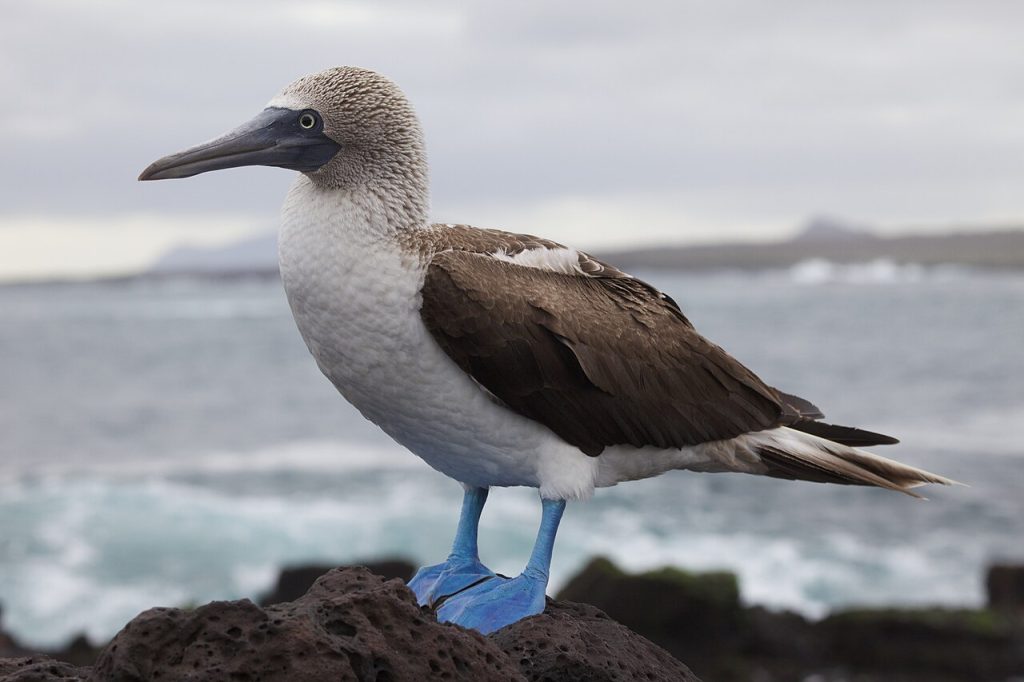
The bird is instantly recognizable by its striking blue feet. This feature plays a crucial role in its social and reproductive behavior. The vibrant coloration comes from pigments obtained through a diet rich in fresh fish. It also indicates the bird’s overall health and nutritional condition. Brighter feet are associated with youth, fertility, and superior parenting ability, making them highly attractive to potential mates. During courtship, males perform an elaborate high-stepping display that showcases their feet. Both males and females also perform a ritualized dance. They raise their wings, point their bills toward the sky, and produce whistles and calls before mating.
Built for the Dive
Blue-footed Boobies possess the streamlined body shape typical of plunge-diving seabirds. They have long, narrow wings, a pointed tail, and a sturdy bill adapted for catching fish. Adults appear brownish above with white underparts and fine streaking on the head. Younger birds tend to have duller coloration.
Females are generally larger than males, measuring between 80 and 90 centimeters in length. Their wingspan reaches up to 1.6 meters, and they weigh approximately 1.5–2 kilograms. Males are slightly smaller, ranging from 80 to 85 centimeters in length. Their wingspan reaches up to 1.5 meters, and they weigh around 1.2–1.6 kilograms. Females often display brighter blue feet, whereas males typically possess larger tails and smaller pupils.
Masters of the Hunt
These seabirds spend much of their lives at sea and return to land mainly for breeding and resting. At dawn, they leave their nesting grounds and search the ocean for food. They frequently hunt in coordinated groups. Their diet consists mainly of small schooling fish such as sardines, anchovies, mackerel, and flying fish. They may also consume squid and fish remains when available.
After locating prey, they perform spectacular plunge dives. They fold their wings tightly against their bodies before entering the water from heights of up to 30 meters. Specialized air sacs beneath the skin cushion the impact and protect the brain. This allows the birds to pursue prey to depths of around 24 meters below the surface. They can also dive directly from a floating position on the water.
Family Life on the Ground
Unlike many birds, Blue-footed Boobies do not build traditional nests. Instead, they lay their eggs directly on open ground. During incubation, both parents take turns warming the eggs with their large webbed feet. These feet contain an extensive network of blood vessels that transfers heat efficiently.
A typical clutch consists of two or three pale bluish eggs, though usually only one or two chicks survive to hatch. As incubation progresses, the adults defecate around the nesting site. This creates a ring of guano that gradually forms a visible boundary around the eggs. After hatching, both parents share responsibility for feeding, protecting, and keeping the chicks warm. They often shelter them beneath their feet.
Keeping Cool Under the Sun
To cope with the intense heat of their coastal and island habitats, Blue-footed Boobies employ several unique cooling mechanisms. One of the most notable is urohydrosis. In this process, they defecate on their feet and legs, allowing evaporation to lower body temperature. They also cool themselves by rapidly vibrating the skin of their throat pouch. This increases airflow and promotes evaporative heat loss through the mouth.
Voices Across the Colony
Although generally quiet while foraging at sea, Blue-footed Boobies become more vocal during the breeding season. Their communication includes whistles, grunts, and trumpeting sounds. Mated pairs can recognize each other’s calls among large colonies. These vocalizations play an important role in maintaining pair bonds and coordinating parental duties.
Challenges for the Future
The species faces several conservation challenges. Declining populations of sardines and other prey fish have reduced breeding success in some areas, particularly in the Galápagos. Marine plastic pollution, climate change, and ocean acidification may further threaten food availability. As a result, researchers and conservation organizations continue to monitor Blue-footed Booby populations. They also work to protect the marine ecosystems essential to the species’ survival.